
Antibiotic suspensions are among the most commercially important, most technically demanding, and most unforgiving products in Indian pharma marketing. Commercially important because the paediatric antibiotic market is enormous and repeat-prescribing once a physician trusts a product drives steady, predictable revenue. Technically demanding because taste-masking, redispersibility, and stability all need to work simultaneously. Unforgiving because a batch that fails taste — even one that passes every pharmacopoeial specification — will be quietly dropped by the prescribing physician without a formal complaint.
This guide breaks down the formulation and manufacturing specifics that matter most for brand owners evaluating antibiotic suspensions for their portfolio.
New to suspension manufacturing generally?
Start with our Syrup & Suspension Manufacturing Guide for MOQ, pricing, and process fundamentals, and our Pediatric Syrup Taste Masking Guide before diving into antibiotic-specific detail.
Ready Suspension vs Dry Syrup: The Stability Decision
The first decision in antibiotic suspension manufacturing isn’t the molecule — it’s the format. And this decision is driven entirely by API stability in aqueous environments.
Most antibiotic APIs are hydrolytically unstable: they degrade when dissolved in water at room temperature. The degradation rate depends on pH, temperature, and the specific molecule, but for most antibiotics — azithromycin, cefixime, amoxicillin — the rate is fast enough that a pre-filled liquid suspension would have an unacceptably short shelf life.
This is why the dry syrup for reconstitution is the standard format for almost all first-line paediatric antibiotic suspensions:
| Format | How It Works | When It’s Used |
|---|---|---|
| Dry Syrup (Reconstituted) | Powder blend in bottle; water added before use; patient uses within 7–14 days | Hydrolytically unstable APIs (azithromycin, cefixime, amoxicillin, cefpodoxime) |
| Ready-to-Use Liquid Suspension | Pre-filled liquid; requires cold chain (2–8°C) after opening | More stable APIs where convenience justifies cold chain cost |
The manufacturing process differs significantly: dry syrups require a granulation or particle-coating step to produce a free-flowing powder that reconstitutes evenly, while ready-to-use suspensions require direct liquid suspension manufacturing with full suspending agent, preservative, and viscosity control.
View Azithromycin Oral Solution · Amoxicillin Oral Suspension · Cefixime Oral Suspension
Cefpodoxime Oral Suspension · Ofloxacin Oral Suspension · Cefixime + Ofloxacin Dry Syrup
Taste Masking: The Commercial-Critical Formulation Step
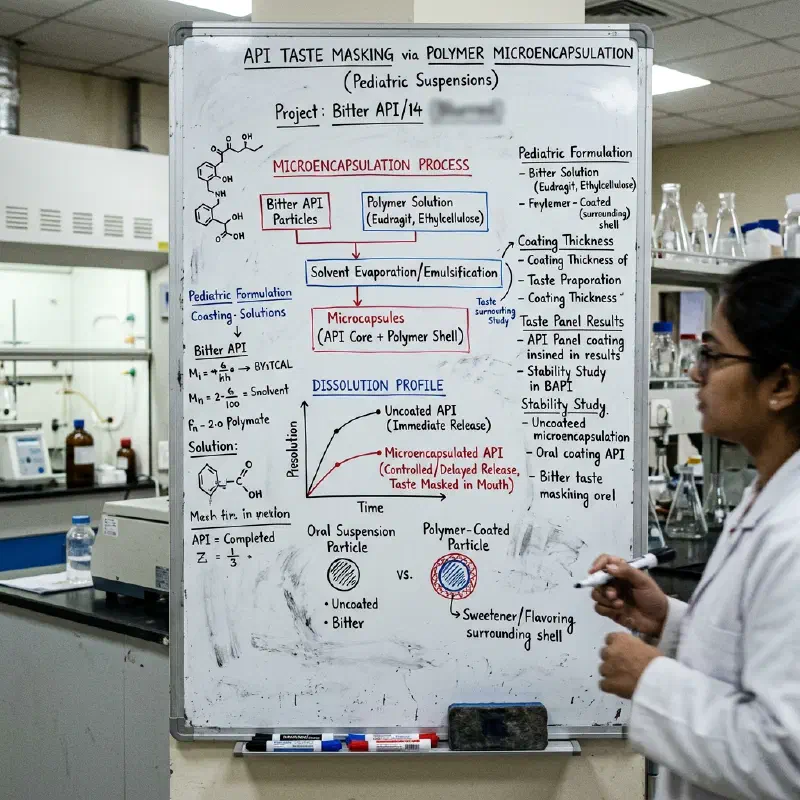
Bitter API taste-masking in paediatric antibiotic suspensions is where formulation chemistry and commercial outcomes intersect most directly. A suspension that tastes acceptable gets prescribed repeatedly. One that children spit out gets quietly switched.
The bitterness challenge varies by molecule:
| Antibiotic API | Bitterness Intensity | Primary Masking Strategy |
|---|---|---|
| Azithromycin | Very high — one of the most bitter antibiotics | Polymer microencapsulation of API particles + flavour system |
| Cefixime | High | Sweetener + flavour masking; sometimes granulation with film |
| Amoxicillin | Moderate | Sweetener and flavour system usually sufficient |
| Ofloxacin | Moderate-high | Flavour system + taste-threshold suppression |
| Cefpodoxime | High | Polymer coating or ion-exchange resin masking |
Taste masking in dry syrups relies on a combination of:
- Polymer microencapsulation of API particles (Eudragit EPO and similar polymers coat the particle surface to prevent API contact with taste receptors)
- Sweetener selection — sucrose, sucralose, aspartame, or sorbitol for sugar-free; each has different intensity and aftertaste profiles
- Flavour system — strawberry, mixed fruit, banana, or orange are most common for Indian paediatric products; the flavour should complement the sweetener rather than fight the API’s bitterness
- pH adjustment — bitterness threshold varies with pH; some APIs are less bitter in slightly acidic or alkaline environments
Redispersibility: The Suspension-Specific QC Test
A suspension is, by definition, a preparation where particles are dispersed in a liquid medium — not dissolved. Those particles will settle over time. This is normal. What’s critical is that when a patient or caregiver shakes the bottle, the settled particles redisperse completely and uniformly.
If they don’t, the dose is non-uniform: the first few doses drawn from the bottle may be too dilute (mostly liquid, few particles), and the last doses may be over-concentrated (settled particles at the bottom). In a fixed treatment course antibiotic, a non-uniform dose can mean clinical treatment failure.
Redispersibility testing for antibiotic suspensions at Saar Biotech involves:
- Settling rate study — the suspension is stored undisturbed at standard conditions; the rate and extent of settling is measured over time
- Redispersion test — after a defined settling period, the bottle is shaken in a standardised pattern; the suspension is evaluated for complete and uniform redispersion
- Dose uniformity from settled state — content uniformity of the dose is confirmed after redispersion, not just from a freshly mixed suspension
This is a test that standard syrup manufacturers — who deal with solutions, not suspensions — may not have a validated protocol for. Always confirm your manufacturer has redispersibility testing built into their development and batch release process for suspension products.
Preservative Efficacy in Reconstituted Dry Syrups
Once a dry syrup is reconstituted with water, it becomes a multi-dose liquid susceptible to microbial contamination during the treatment course. The preservative system must:
- Inhibit microbial growth throughout the 7–14 day in-use period at the storage temperature specified on the label
- Not interact with the antibiotic API in a way that accelerates degradation
- Not produce a taste or odour that worsens patient acceptability
Common preservative choices for antibiotic dry syrups include sodium benzoate, potassium sorbate, and methylparaben — each with different API compatibility profiles. For sugar-free formulations, the interaction between the sweetener system and the preservative also needs to be validated.
Combination Antibiotic Suspensions: Additional Considerations
Combination formulations — Ofloxacin + Ornidazole, Cefixime + Clavulanic Acid, Amoxicillin + Clavulanic Acid — add regulatory and formulation complexity beyond single-molecule products.
From a formulation standpoint, the challenge is physicochemical compatibility between the two APIs in the suspension matrix — they must coexist without one accelerating the degradation of the other. This requires compatibility testing before stability studies begin.
From a regulatory standpoint, combination products are Fixed-Dose Combinations (FDCs) and must be approved by CDSCO under the specific combination ratio. Before ordering artwork or committing to a combination antibiotic suspension, confirm that the exact combination and ratio you intend to market has valid CDSCO FDC approval.
View Ofloxacin-Ornidazole Suspension · Ofloxacin-Metronidazole Suspension · Ofloxacin-Tinidazole Suspension
Building Your Antibiotic Suspension Portfolio
For a pharma marketing company building a complete antibiotic product line, a logical starter sequence:
- First launch: Azithromycin 200mg/5ml dry syrup — highest physician familiarity, broad ENT and respiratory indication, and a molecule where taste masking is the clear quality differentiator
- Second: Cefixime 50mg/5ml dry syrup — strong prescribing in resistant respiratory and UTI, complements azithromycin across infection types
- Third: Amoxicillin 125mg/5ml — high volume, accessible MOQ, still the first-line choice for many GPs in straightforward respiratory infections
Ofloxacin and combination formulations are solid additions once the simpler single-molecule range is established and physician relationships are built around the core product quality.
Browse the full Dry Syrups & Antibiotic Suspensions range or the complete Suspensions Manufacturing catalogue.
Conclusion
Antibiotic suspensions are unforgiving products to get wrong — and unusually rewarding to get right. A well-formulated paediatric antibiotic suspension with genuine taste masking and consistently uniform redispersion builds physician trust faster than almost any other product category, because the prescribing doctor sees the outcome directly: the child completes the course, the infection clears, and the brand gets written again.
The questions to ask a prospective manufacturer before committing: Do they run sensory panel testing on taste masking? Do they have validated redispersibility protocols? Do they run PET on every commercial batch? Manufacturers who can answer those questions specifically — with documentation — are the ones worth partnering with.
Ready to develop an antibiotic suspension for your brand?