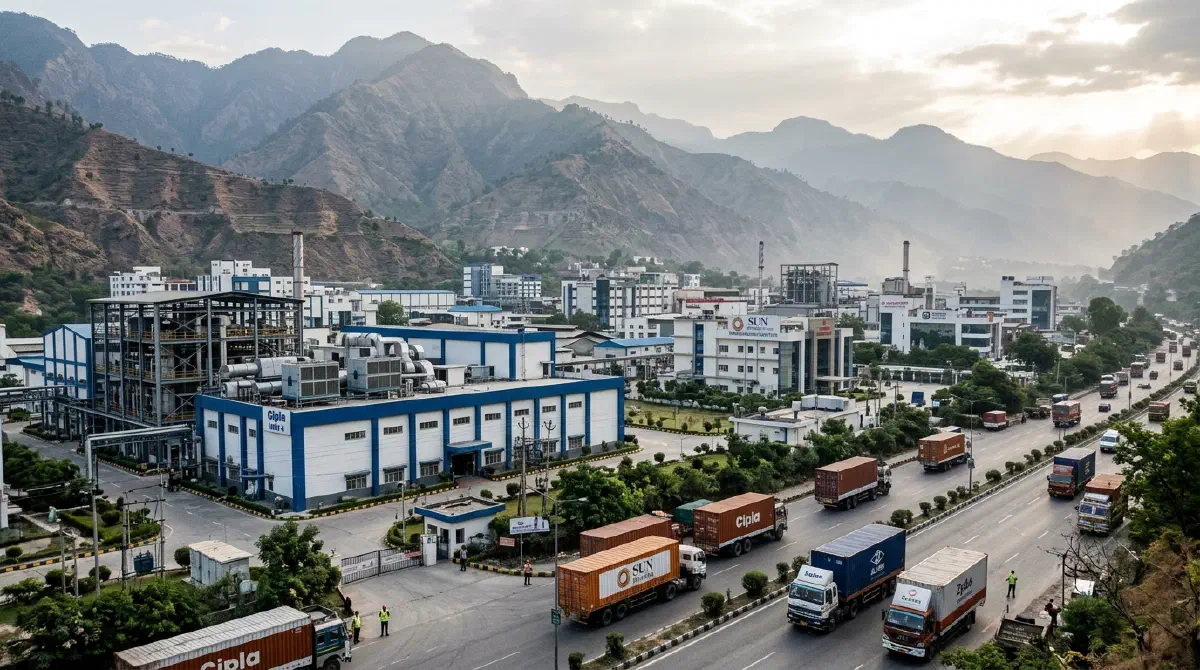
Executive Overview: The Year That Defined Modern Indian Pharma Manufacturing
As 2026 draws to a close, the Baddi-Barotiwala-Nalagarh (BBN) industrial belt in Himachal Pradesh stands transformed. What began two decades ago as an incentive-driven manufacturing zone has matured into a hyper-efficient, technologically sophisticated global pharmaceutical powerhouse.
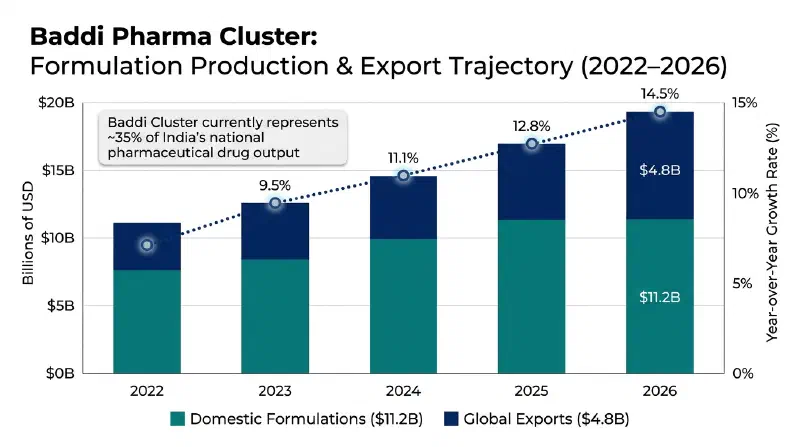
Today, Baddi accounts for nearly 35% of India’s domestic drug formulations and generated an estimated $16 Billion in combined output ($11.2 Billion domestic + $4.8 Billion exports) over the past calendar year.
1. Production Output & Export Acceleration in 2026
Despite global macroeconomic headwinds, active pharmaceutical ingredient (API) price fluctuations, and increasing regulatory inspections, Baddi recorded strong production resilience in FY 2026:
Key Economic Drivers:
- Export Expansion: Shipments of finished dosage formulations from Baddi to emerging markets (ASEAN, Africa, Central Asia, and Latin America) expanded by 14.5% year-over-year, propelled by WHO-GMP certified facilities meeting overseas pharmacopoeial standards.
- Domestic Volume Resilience: The Indian pharmaceutical market crossed ₹2.3 Lakh Crore in retail value, with Baddi-based contract manufacturers supplying the core volume of essential antibiotics, analgesics, gastrointestinal suspensions, and dermatologics.
- Localization of Packaging and Raw Materials: Over 85% of secondary packaging (cartons, foils, corrugated shippers) and primary PET containers are now sourced within a 25-kilometer radius of Baddi plants, insulating brand owners from port disruptions.
2. Revised Schedule M: The Great Quality Bifurcation
The dominant industry narrative of 2026 was the nationwide enforcement of the Union Health Ministry’s Revised Schedule M regulations. Designed to harmonize Indian manufacturing standards with global WHO-GMP and PIC/S (Pharmaceutical Inspection Co-operation Scheme) guidelines, the revised framework fundamentally separated compliant CDMOs from unupgraded job-workers.
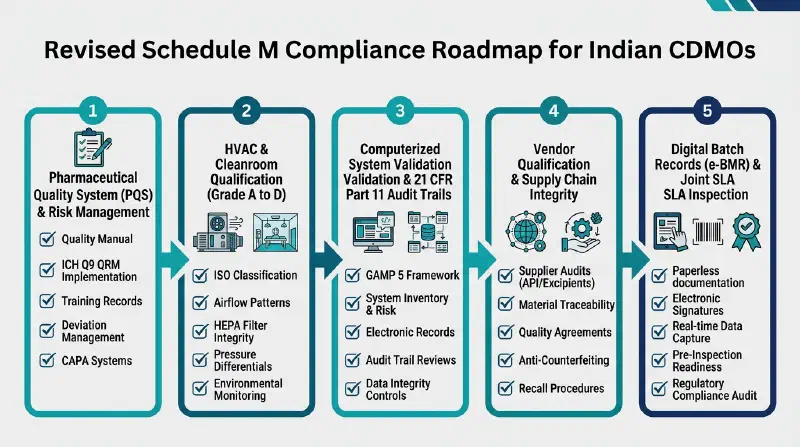
Tangible Operational Upgrades Mandated in 2026:
- Pharmaceutical Quality System (PQS) & Risk Management:
- Transition from reactive testing to proactive Quality Risk Management (ICH Q9). Every production run requires documented risk assessments and formal Corrective and Preventive Actions (CAPA).
- Environmental & Cleanroom Zoning (HVAC):
- Stricter air change per hour (ACPH) minimums, continuous differential pressure monitoring, and HEPA filter integrity (DOP/PAO testing) across all Grade A to D suites.
- Computerized Systems Validation (CSV) & Data Integrity:
- Elimination of manual spreadsheet calculation sheets in analytical testing. All HPLC, dissolution apparatus, and spectrophotometers now require 21 CFR Part 11 compliant audit trails with multi-tier biometric access.
- Supply Chain Traceability & Anti-Counterfeiting:
- Comprehensive vendor qualification audits and mandatory 2D data matrix barcoding on top-selling pharmaceutical brands.
3. Infrastructure & Logistics Milestones
Significant physical and digital connectivity enhancements reached completion in Himachal Pradesh throughout 2026:
| Infrastructure Project | Operational Status (2026) | Strategic Benefit for Pharma Brand Marketers |
|---|---|---|
| Pinjore-Baddi 4-Lane Expressway | Fully Commissioned | Slashes container transit times between Baddi plants and Chandigarh airport to under 45 minutes |
| Baddi Inland Container Depot (ICD) | Modernized Logistics Hub | Direct on-site customs clearance for export cargo heading to Mundra and Nhava Sheva ports |
| BBN Common Effluent Treatment Plant (CETP) | Zero-Liquid Discharge (ZLD) Upgrade | Ensures environmental sustainability and compliance with Himachal Pradesh Pollution Control Board (HPPCB) |
| Uninterrupted Green Grid Power | 220 kV Substation Additions | Eliminates diesel generator usage, lowering manufacturing carbon footprints and batch utility surcharges |
| Central Drug Testing Laboratory (CDTL) Baddi | NABL & CDSCO Accredited | Fast-tracks state regulatory batch testing and verification of suspect spurious formulations |
4. The Rise of Specialized CDMOs: Beyond Simple Generics
In previous decades, Baddi was predominantly known as a tablet-compression and basic generic packing center. In 2026, intense price competition and NPPA price controls accelerated a decisive transition toward specialized, technologically demanding dosage forms:
- Complex Liquid Orals & Suspensions: High-viscosity gastro-protective suspensions (Sucralfate + Oxetacaine, Sodium Alginate raft-forming suspensions) and taste-masked pediatric drops requiring specialized vacuum homogenizers.
- Moisture-Sensitive Dry Syrups: Dedicated, dehumidified cleanroom suites (RH < 35%) producing Cefixime, Ofloxacin, and Cefpodoxime powder formulations.
- Topical Dermatologics: Micronized antifungals (Luliconazole, Terbinafine) and corticosteroid emulsions packed in multi-layer lamitubes and airless lotion dispensers.
- Metered Nasal Sprays: Cleanroom assembly lines equipped with automated automated actuation force testers and droplet distribution analyzers.
5. What the 2026 Baddi Landscape Means for Pharma Brand Owners in 2027
For pharmaceutical entrepreneurs, PCD franchise distributors, and hospital procurement directors, the consolidation of the Baddi industrial belt offers distinct strategic clarity:
[Legacy Job-Work Era (Pre-2024)]          [Modern CDMO Ecosystem (2026–2027)]
• Fragmented manual paper logs            • Validated digital e-BMRs & audit trails
• Price-only bidding                      • Quality-first, regulatory-proof production
• Unreliable HVAC & cross-contamination   • ISO Grade D/C suites with zero air bypass
• High batch recall risk                  • Zero-defect release with full COA traceability
Strategic Recommendations for Brand Owners Entering 2027:
- Audit Your Manufacturer’s Schedule M Dossier: Do not wait for state licensing inspections. Ensure your manufacturing partner has a verified Joint SLA / CDSCO compliance certificate.
- Leverage Turnkey CDMOs: Outsource formulation development, artwork compliance, stability testing, and batch production to unified partners like Saar Biotech to compress product launch cycles.
- Focus on High-Barrier Formulations: Shift promotional budgets toward taste-masked pediatric suspensions, specialized dry syrups, and dermatology creams where margins remain insulated from commoditization.
Frequently Asked Questions (Baddi Pharma Hub)
Manufacture in Baddi with Saar Biotech in 2027
As one of Baddi’s leading third-party manufacturing organizations, Saar Biotech offers state-of-the-art infrastructure fully aligned with Revised Schedule M, WHO-GMP, and international pharmacopoeial standards.
- Explore our Liquid Orals & Syrups Manufacturing Infrastructure.
- Review our advanced Topical Dermatology Capabilities.
- Read our guide on How to Choose a Third-Party Pharma Manufacturer.
- Inspect our regulatory credentials on our WHO-GMP Compliance Page.
- Plan your 2027 commercial product pipeline on our Interactive B2B Brief Planner.
- Contact our executive management team via our Contact Page.