The cough and cold category is one of the most commercially reactive categories in Indian pharma — and one of the most operationally mismanaged by brand owners who treat it as a year-round product with occasional peaks rather than a seasonal product that requires forward planning.
A brand that runs out of cough syrup stock in November, when physician recommendation rates are highest, doesn’t just lose that month’s revenue — it loses the prescription momentum it spent the year building. Physicians who can’t find your brand at the pharmacy twice in the same season move on to the one that’s reliably available.
This article is for brand owners who want to avoid that failure mode. The focus is operational: when to order, how much to order, and which formulations to prioritise.
Exploring the full respiratory product range?
See our Top Respiratory Products for Third-Party Manufacturing for a broader category overview, and the Paediatric Syrup Taste Masking Guide for formulation specifics.
Understanding the Demand Pattern
Cough and cold syrup demand in India is not uniformly seasonal — the pattern varies significantly by geography and formulation type:
| Region | Peak Demand Period | Dominant Driver |
|---|---|---|
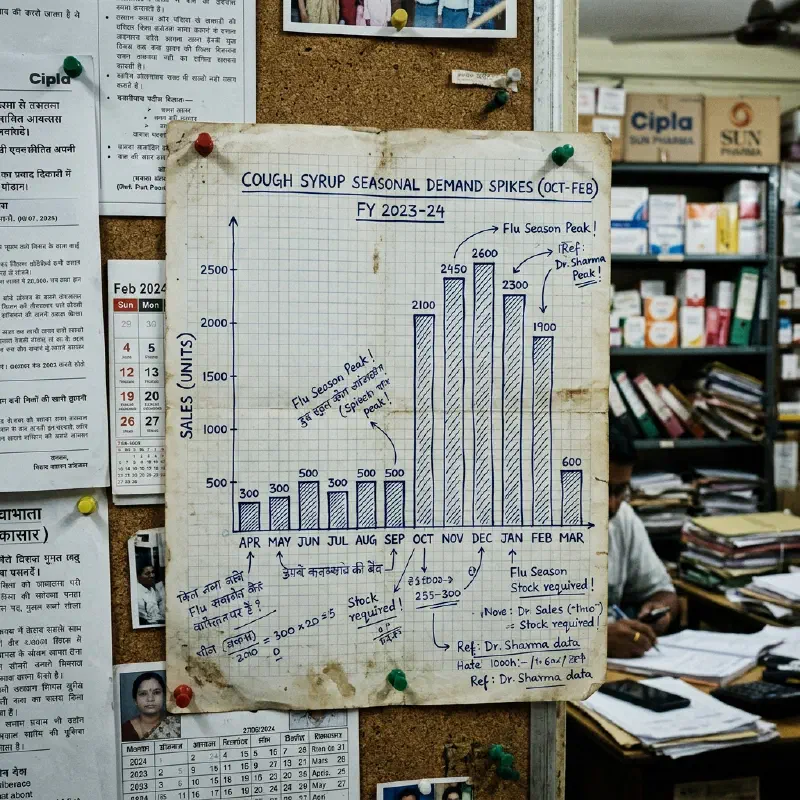
| North India (Delhi NCR, UP, Punjab, Haryana) | October — February | Winter cold weather, post-monsoon temperature drops |
| Himachal Pradesh / Uttarakhand | September — March | Extended cold season, altitude effect |
| Eastern India (WB, Bihar, Odisha) | October — January | Post-monsoon chill, humidity |
| South India (Tamil Nadu, Karnataka, Andhra) | June — August (monsoon) + Nov–Jan | Monsoon-associated respiratory illness + mild winter |
| Western India (Maharashtra, Gujarat) | November — February | Relatively mild; shorter peak |
The practical implication: for pan-India brands, manufacturing planning should target the October–January window as the primary peak. For region-specific brands in the North, the planning horizon starts in August.
Planning Backwards: The Seasonal Order Calendar
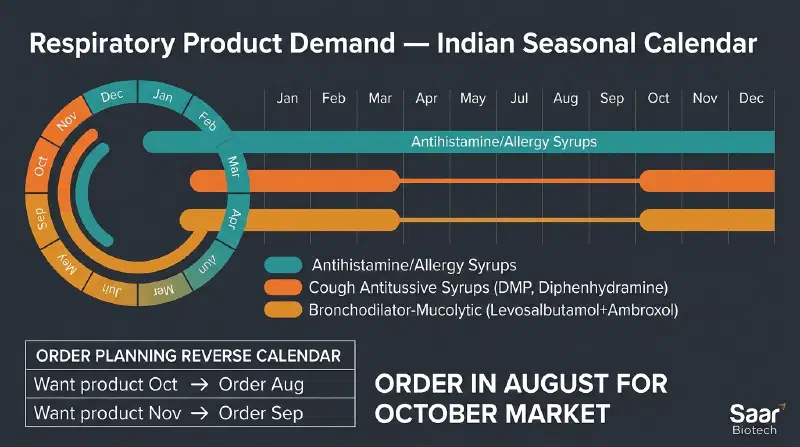
The cough syrup planning mistake most brands make is treating the manufacturing timeline as a constant they can compress when needed. It isn’t. A 30–45 working day manufacturing timeline for a validated formulation is the floor, not a guideline — and it assumes artwork is already approved.
| If You Want Product in Market By… | Place Manufacturing Order By… | Artwork Must Be Approved By… |
|---|---|---|
| October 1 (early season) | August 10 | August 1 |
| November 1 (peak season start) | September 10 | September 1 |
| December 1 (mid-peak) | October 10 | October 1 |
| January 15 (last effective peak window) | November 25 | November 15 |
The Two Segments: Paediatric vs Adult Formulations
Cough and cold syrups divide commercially into two distinct segments with different formulation requirements, prescribing contexts, and physician relationships:
Paediatric Cough Formulations
The paediatric respiratory segment is driven primarily by GP and paediatrician prescribing for the fever-plus-cough presentation, which is one of the highest-volume clinical presentations in Indian outpatient practice.
Key formulation features:
- Lower API concentrations per ml — dosed by weight or age
- Aggressive taste-masking — children’s cough syrups must be palatable or compliance fails immediately
- Smaller bottle sizes — 60ml standard (1–2 week paediatric course)
- Clear, flavoured base — strawberry, mixed fruit dominant
- Age-appropriate dosing device — 5ml measuring spoon or oral syringe included
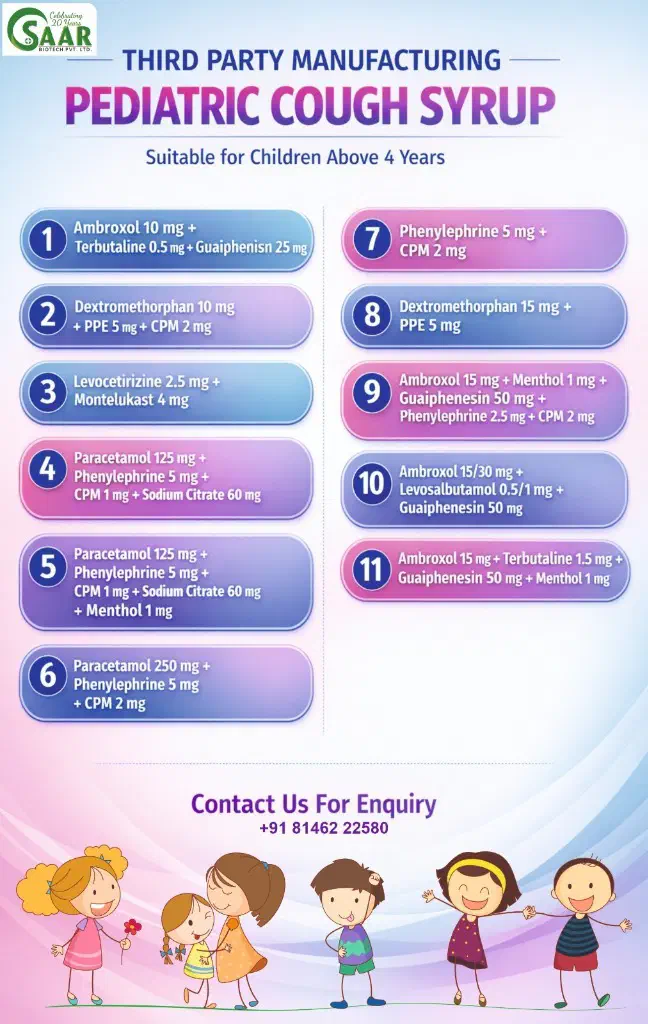
Top paediatric respiratory compositions:
| Composition | Clinical Indication | Pack Size |
|---|---|---|
| Levosalbutamol + Ambroxol + Guaiphenesin | Bronchospasm with productive cough | 60ml |
| Ambroxol + Dextromethorphan + Phenyephrine + CPM + Menthol | Multi-symptom upper respiratory | 60ml |
| Levocloperastine Suspension | Dry cough, specific paediatric use | 60ml |
| Paracetamol + Phenylephrine + CPM | Fever with nasal congestion + cold | 60ml / 100ml |
Adult Expectorant-Bronchodilator Combinations
The adult segment spans GP, pulmonology, and ENT prescribing. The formulations are more potent, bottles larger, and physician relationships often more specific to individual prescription preference.
Key formulation features:
- Standard concentration per 5ml dose
- Taste-masking still important — adults spit out unpalatable syrups too, just less dramatically
- 100ml or 200ml bottles — longer or higher-dose courses
- Menthol can be used more freely — adult respiratory products with a cooling sensation are preferred by many prescribers
Top adult respiratory compositions:
| Composition | Clinical Indication | Pack Size |
|---|---|---|
| Levosalbutamol + Ambroxol + Guaiphenesin | COPD, bronchitis, productive cough | 100ml |
| Terbutaline + Ambroxol + Guaiphenesin + Menthol | Bronchospasm with mucus congestion | 100ml |
| DMP + CPM + Phenylephrine + Menthol | Common cold antitussive | 100ml |
| Diphenhydramine + Ammonium Chloride + Sodium Citrate + Menthol | Sedating cough syrup | 100ml |
| Loratadine + Guaifenesin + Ambroxol | Non-sedating antihistamine-expectorant | 100ml |
Repeat Batch Strategy: More Efficient Than One Large Order
For seasonal cough syrups, the financially optimal manufacturing strategy is:
Batch 1 (August–September order): Conservative — sized for 60 days of expected demand. This de-risks the first season without committing to large inventory if the product doesn’t achieve expected distribution or prescription penetration.
Batch 2 (October order, shipped late October): Larger — based on actual Batch 1 sell-through. If Batch 1 moved faster than expected, scale up. If it’s moving slowly, keep Batch 2 at a similar size and investigate distribution rather than increasing manufacturing.
Batch 3 (December order for January): Positioned to carry through peak season end. After February, cough syrup demand drops sharply in North India — don’t manufacture stock you’ll be carrying through summer.
Key Products Available at Saar Biotech
Browse our Syrups Manufacturing range for all available cough and respiratory formulations, and our Promotions: Paediatric Cough Syrups page for seasonal campaign-ready products.
Conclusion
Seasonal demand planning for cough syrups is a reverse-calendar exercise: start from the month you need product in the pharmacy, subtract the manufacturing timeline, and work backwards to when artwork and the manufacturing contract must be finalised. Most brands who run out of seasonal stock in November didn’t have a manufacturer problem — they had a planning horizon problem.
Order by August for the winter season. Size your first batch conservatively. Repeat at 60–90 day intervals based on actual sell-through. That’s the operational playbook.
Ready to plan your seasonal cough syrup manufacturing?