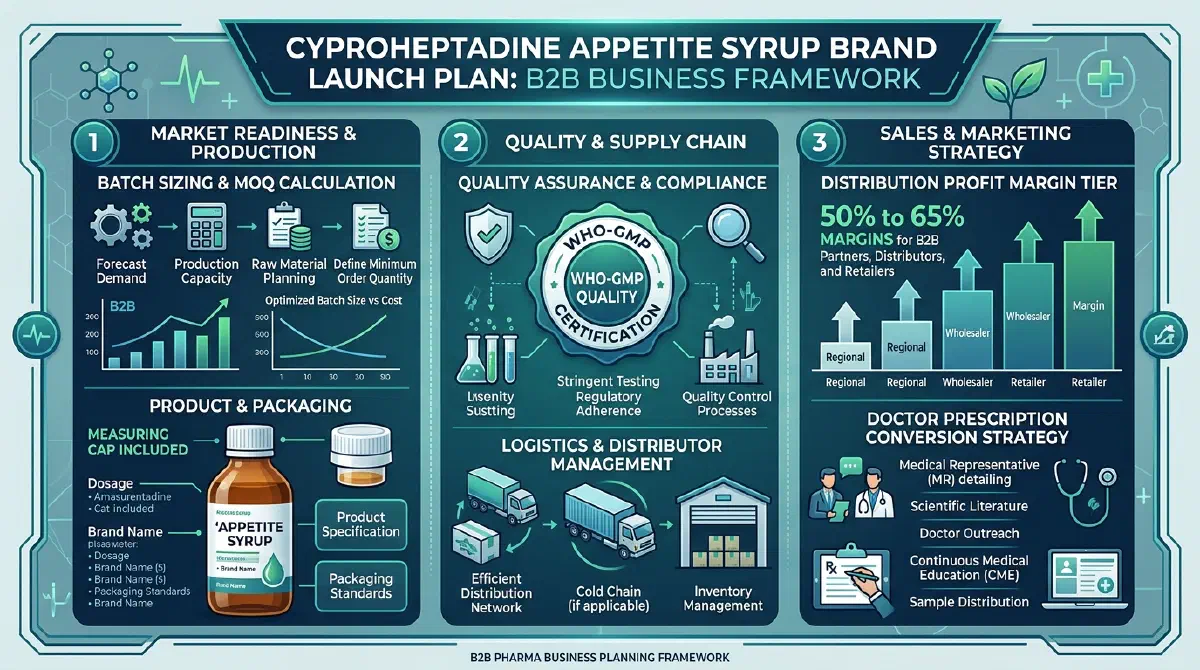
Strategic Overview: The Commercial Case for Appetite Stimulant Syrups
For emerging pharmaceutical marketing companies, PCD franchise distributors, and hospital procurement networks, Cyproheptadine Hydrochloride (2mg/5ml) + Tricholine Citrate (275mg/5ml) Syrup represents one of the most reliable foundation products in liquid orals. Known clinically as the formulation behind commercial giants like Cypon (Geno Pharmaceuticals) and Practin (Cipla), this combination combines high clinical frequency with favorable manufacturing economics.
1. Batch Economics, Sizing & Minimum Order Quantities (MOQ)
Launching a successful liquid oral brand requires balancing cash flow with production scale economies:
| Production Tier | Batch Size (Bottles) | Target Pack | Unit Economics Advantage | Ideal Marketer Profile |
|---|---|---|---|---|
| Pilot / Startup Batch | 3,000 – 5,000 | 100ml / 200ml | Low initial capital risk | New PCD Franchisees & Regional Startups |
| Growth Commercial Batch | 10,000 – 15,000 | 200ml | 12% lower unit packaging cost | Established State Distributors |
| Institutional / Tender Run | 25,000+ | 100ml / 200ml | Maximum raw material compounding yield | Multi-state Brands & Hospital Chains |
- Raw Material Compounding Efficiency: Compounding in 1,000L to 3,000L jacketed SS-316L vessels ensures absolute batch uniformity with tight potency margins.
- Packaging Wastage Minimization: Automated rotary bottling ensures sub-0.5% fill loss, directly lowering the finished goods cost per unit.
2. Packaging Engineering & Market Presentation
Market acceptance among chemists, pediatricians, and consumers is heavily influenced by packaging ergonomics:
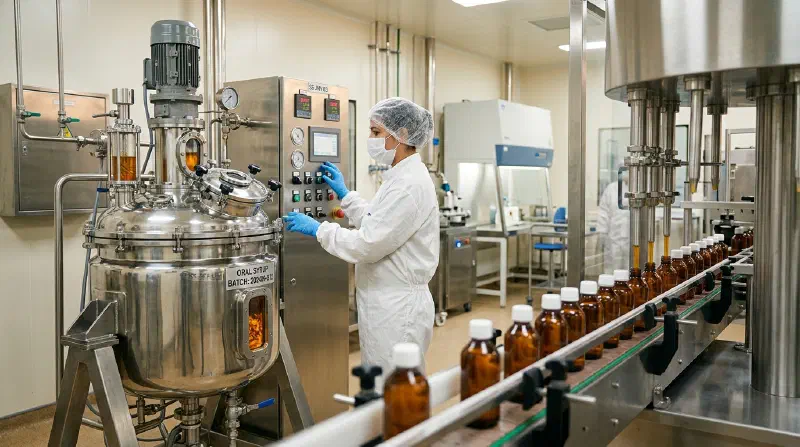
- Primary Container: Amber polyethylene terephthalate (PET) bottles offering 100% photolytic UV protection for light-sensitive cyproheptadine molecules.
- Closure Systems: ROPP (Roll-On Pilfer-Proof) or Child-Resistant caps fitted with expanded polyethylene (EPE) wads to prevent transit leakage.
- Dosage Precision: Every unit includes a calibrated polypropylene (PP) measuring cup (2.5ml, 5ml, 10ml graduation) to guarantee pediatric dosing compliance.
- Outer Mono Carton: 350 GSM premium duplex/FBB carton featuring drip-off UV spot coating, embossed brand titling, and clear bilingual consumer guidelines.
3. Distribution Margin Tiers & Profitability Modeling
To drive prescription traction against entrenched national brands, emerging brand owners must offer compelling margins across distribution layers:
[Ex-Factory Cost + GST] ──> [Super Stockist: 8%–10%] ──> [Stockist/Distributor: 12%–15%] ──> [Retail Chemist: 20%–25%] ──> [MRP]
                                            └─ Overall Gross Margin Pool: 50% to 65% ─┘
- Gross Margin Buffer: Healthy margins allow brand owners to invest in high-yield medical representative (MR) promotional kits, visual aids, sample bottles, and physician reminder cards.
- Prescription Conversion Strategy: Emphasize dual therapeutic coverage — appetite stimulation through hypothalamic 5-HT2 antagonism + hepatoprotective lipotropic action for pediatric and convalescent patients.
4. Regulatory Dossier & Quality Assurance Checklist
Under revised Schedule M and CDSCO directives, private label brand marketers must verify manufacturing credentials:
- WHO-GMP Certification: Guarantees international standards in water purification (Reverse Osmosis + EDI generating purified water meeting IP/BP specifications).
- Analytical Documentation: Every production run is accompanied by a comprehensive Certificate of Analysis (COA) confirming HPLC active assay, microbial limits, and heavy metal compliance.
- Digital Traceability: Complete batch manufacturing records (BMR) and SUGAM portal integration for swift state licensing approvals.
Frequently Asked Questions (B2B Commercial)
Partner with Saar Biotech for Your Appetite Syrup Brand
Ready to manufacture Cyproheptadine + Tricholine Citrate Syrup under your own pharmaceutical brand name?
- Review detailed product specifications on our Cyproheptadine Syrup Product Page.
- Read our consumer-facing clinical guide: Cyproheptadine Syrup Uses in Hindi.
- Explore our full Syrups Manufacturing Portfolio.
- Calculate batch sizing and unit economics using our Interactive Brief Planner.
- Request a commercial quotation directly via our Contact Us Page.
- Inspect our manufacturing credentials on the WHO-GMP Compliance Overview.