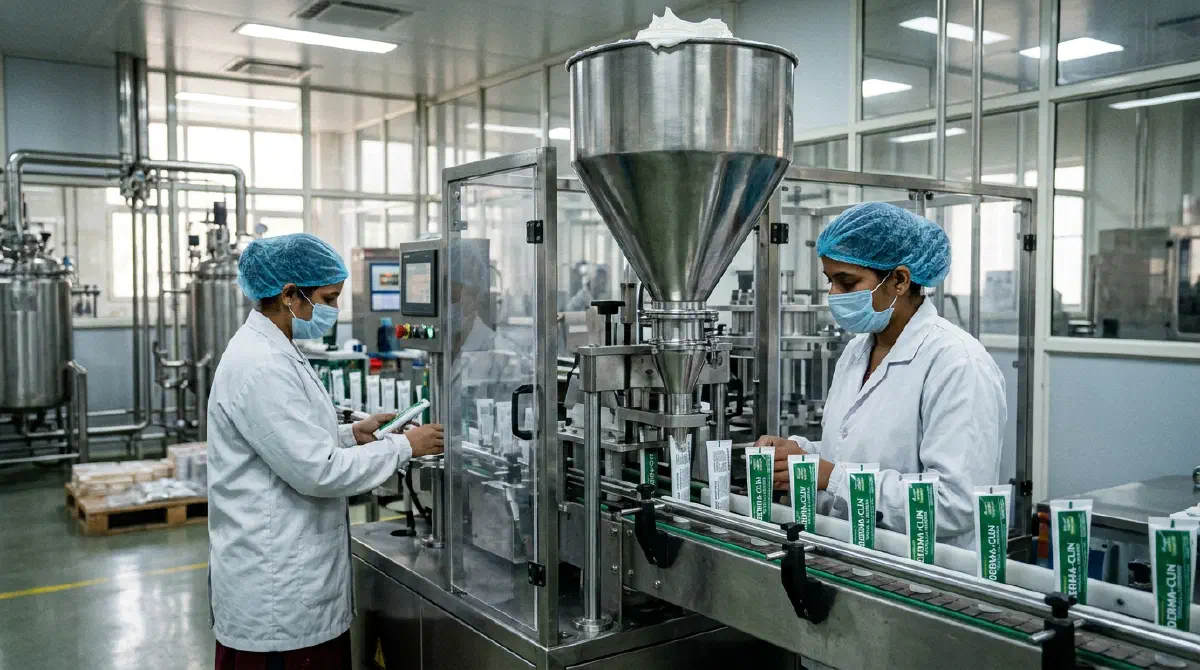
Strategic Overview: The Indian Dermatology Landscape in FY 2026
The domestic pharmaceutical market for topical dermatological formulations has evolved into one of the most resilient, high-margin therapeutic segments in India. In FY 2026, the sector recorded ₹14,800+ Crore in domestic retail turnover, reflecting a compound annual growth rate (CAGR) of 12.4%.
Unlike seasonal anti-infective or acute cough therapies, dermatological conditions generate chronic, continuous prescription renewals. Driven by lifestyle shifts, environmental humidity, rising consumer aesthetic awareness, and chronic fungal epidemics across Northern, Western, and Southern states, dermatology offers private-label brand marketers reliable baseline cash flow.

1. FY 2026 Prescription Share by Therapeutic Class
Prescription audit data across consulting dermatologists, general physicians (GPs), and pediatric clinics reveals clear concentration across five dominant categories:
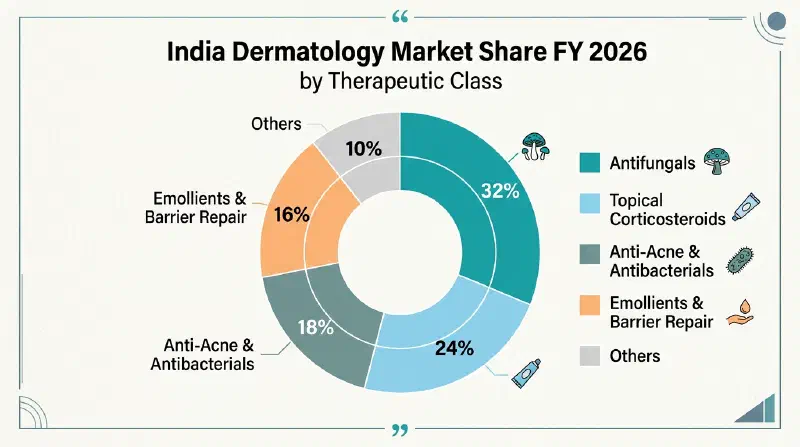
A. Antifungals (32% Market Volume)
India has experienced a prolonged epidemic of recurrent and recalcitrant dermatophytosis (Tinea infections). Older azoles (clotrimazole, miconazole) face elevated clinical failure rates, driving prescription dominance toward advanced fungicidal agents:
- Luliconazole 1.0% w/w Cream: Prescribed for 1–2 week once-daily regimens, offering superior keratin adherence and sustained tissue levels.
- Terbinafine HCl 1.0% w/w Cream: The leading allylamine option for tinea pedis and tinea corporis.
- Sertaconazole Nitrate 2.0% w/w Cream: Broad-spectrum imidazole featuring dual fungicidal and anti-inflammatory action, popular in sensitive intertriginous areas.
- Ketoconazole 2.0% Cream & Shampoos: Sustained volume in seborrheic dermatitis, dandruff management, and pityriasis versicolor.
B. Topical Corticosteroids (24% Market Volume)
Topical corticosteroids represent essential tools for plaque psoriasis, atopic eczema, contact dermatitis, and lichen planus.
- Super-potent: Clobetasol Propionate 0.05% w/w cream and ointment for severe, recalcitrant hyperkeratotic lesions.
- Potent / Mid-potent: Mometasone Furoate 0.1% w/w cream and lotion, widely favored for facial and pediatric eczema due to lower systemic absorption.
- Halobetasol Propionate 0.05% + Salicylic Acid 3% / 6% Ointments: Standard therapy for stubborn palmo-plantar psoriasis and chronic keratoderma.
C. Anti-Acne & Antibacterials (18% Market Volume)
- Clindamycin Phosphate 1% + Nicotinamide 4% Gel: The number one non-irritating topical prescription for inflammatory acne vulgaris.
- Adapalene 0.1% + Benzoyl Peroxide 2.5% Gel: First-line comedolytic and bactericidal dual combination recommended in international dermatology guidelines.
- Mupirocin 2.0% w/w Ointment: Essential topical antibiotic for primary impetigo, folliculitis, and secondary bacterial infections.
- Fusidic Acid 2.0% w/w Cream: Deep skin penetration against Staphylococcus aureus without systemic cross-resistance.
D. Emollients, Ceramide Creams & Barrier Repair (16% Market Volume)
Driven by growing recognition of epidermal barrier disruption, barrier repair lotions are now co-prescribed alongside active therapeutics:
- Calamine + Light Liquid Paraffin + Aloe Vera lotions for soothing pruritus, sunburn, and dry dermatitis.
- Ceramide III, Hyaluronic Acid, and Colloidal Oat moisturizers for post-procedure skin recovery and atopic diathesis.
2. Emulsion Engineering & Manufacturing Science
Manufacturing pharmaceutical creams and ointments requires rigorous control over rheology, globule size distribution, and thermodynamic phase stability.
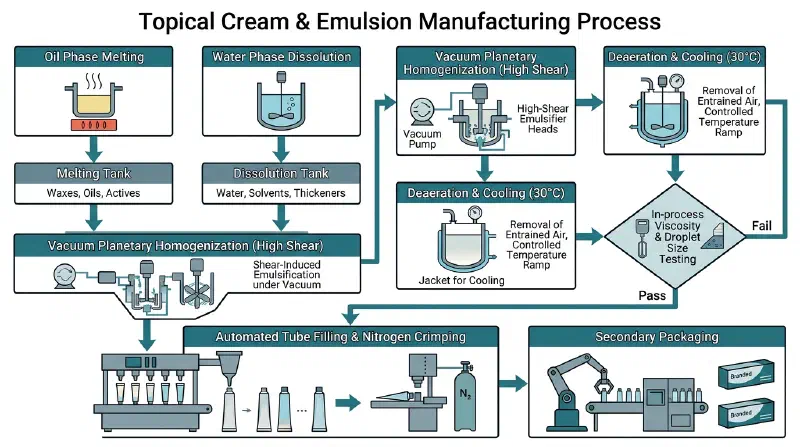
Critical Formulation Hurdles Solved at Saar Biotech:
- Sub-Micron Droplet Homogenization:
- Inadequate shear results in droplet coalescence, oil bleeding, and gritty texture. Our vacuum planetary mixers deliver peripheral speeds exceeding 25 m/s, producing uniform emulsion droplet sizes below 2 microns.
- Deaeration Under High Vacuum:
- Entrained micro-bubbles cause phase separation, localized oxidation, and tube weight fluctuations. We homogenize under -0.8 to -0.9 bar vacuum, ensuring dense, silky smooth, glass-like cream texture.
- Rheology & Viscosity Optimization:
- Validated using digital Brookfield viscometers across shear rates, ensuring optimal thixotropic spreadability: easily spreadable upon gentle friction yet non-runny upon dispensing from the tube nozzle.
- Preservative & Microbial Integrity:
- Emulsions with high water phase activity require synergistic preservative systems (methylparaben/propylparaben or phenoxyethanol blends) validated via Preservative Efficacy Testing (PET / Antimicrobial Effectiveness Testing according to IP/USP).
3. Packaging Matrix: Tube Materials & Functional Sealing
Primary packaging directly dictates topical stability, preventing chemical oxidation and volatile solvent loss:
| Tube Type | Substrate Construction | Key Advantages | Typical Product Applications |
|---|---|---|---|
| Aluminium Collapsible Tubes | 99.7% pure virgin aluminium with internal epoxy lacquer & latex end seal | Complete barrier against oxygen, moisture, and light; zero air suck-back | Clobetasol ointments, Retinoid/Tretinoin gels, Mupirocin formulations |
| Multi-layer LamiTubes (ABL) | Aluminium Barrier Laminate with polyethylene layers | High metallic gloss finish, superior memory retention, bounce-back prevention | Luliconazole cream, Terbinafine cream, Sertaconazole cream |
| Plastic Barrier Tubes (PBL) | Polyethylene laminate with EVOH high-barrier resin | Recyclable, flexible, full-color HD photographic printing | Moisturizing lotions, Calamine barrier creams, Anti-acne cleansers |
| Airless & Lotion Pump Bottles | HDPE / Polypropylene with spring-loaded metering pump | Precise volumetric dose dispensing, prevents fingertip microbial contamination | Calamine lotions, Body moisturizers, Liquid keratolytic solutions |
4. CDSCO Regulatory Compliance: The End of Irrational Triple Cocktails
The Indian dermatology market has undergone significant regulatory housecleaning. The Central Drugs Standard Control Organization (CDSCO) and state licensing authorities have actively revoked permissions for irrational cocktail combinations containing high-potency corticosteroids combined with multiple anti-infectives.
Why This Benefits Quality-Focused Brand Marketers:
- Physician Trust: Dermatologists actively boycott brands selling irrational OTC fixed-dose cocktails. Marketing approved, rational monotherapies establishes medical credibility.
- Sustainable Brand Longevity: Products manufactured strictly compliant with DCGI approvals and revised Schedule M run zero risk of sudden product bans or state confiscations.
- PCD Distributor Confidence: Chemists and stockists face zero legal liability when stocking CDSCO-approved rational topical lines.
5. B2B Commercial Economics & PCD Distribution Margins
Topical dermatology products offer superior unit economics due to compact tube dimensions, minimal freight cube loss, and attractive trade margins:
[Saar Biotech Ex-Factory Manufacturing Cost: ₹18.00 – ₹28.00]
                            │
                            ▼  (+ Freight & 12% GST)
            [Brand Owner Landed Cost: ₹22.00 – ₹33.00]
                            │
                            ▼  (+ Brand Margin Pool: 50% – 65%)
            [PCD Stockist / Franchise Net Rate: ₹45.00 – ₹65.00]
                            │
                            ▼  (+ Wholesale Trade Margin: 10% – 12%)
            [Retail Pharmacy Purchase Price: ₹60.00 – ₹85.00]
                            │
                            ▼  (+ Chemist Retail Margin: 20% – 25%)
            [Maximum Retail Price (MRP): ₹120.00 – ₹220.00 per tube]
Turnkey CDMO Advantages with Saar Biotech:
- Accessible Batch Sizes: Initial production runs starting at 5,000 to 10,000 tubes allow brand owners to launch comprehensive 5-to-10 SKU dermatology portfolios with manageable initial capital.
- Regulatory Dossier Readiness: Complete Certificates of Analysis (COA), finished product specifications, stability data (Zone IVb: 40°C/75% RH), and state licensing endorsement support.
- Rapid Turnaround: 30 to 35 days from artwork sign-off to finished product dispatch from our Baddi facility.
Frequently Asked Questions (B2B Dermatology)
Partner with Saar Biotech for Your Dermatology Portfolio
Are you looking to establish or expand your private-label dermatology line with market-leading topical formulations? Saar Biotech operates advanced, WHO-GMP-certified topical manufacturing suites in Baddi, Himachal Pradesh.
- Explore our Dermatology Products Portfolio.
- Review our dedicated Antifungal Creams Third-Party Manufacturing Guide.
- Learn about Ointments, Gels & Topical Solutions Manufacturing.
- Understand topical tube selection in our Pharma Packaging Trends Guide.
- Size your production batches using our Interactive B2B Brief Planner.
- Contact our technical sales team directly on our Contact Us Page.