
India’s FDC regulatory environment has been one of the most actively enforced areas of pharmaceutical law since 2016. The government’s periodic bans, CDSCO’s ongoing review of unapproved combinations, and the Supreme Court and High Court proceedings that followed have created a regulatory landscape that’s more complex than most brand owners realise.
The practical consequence for a pharma marketing company: an FDC combination you see being sold by competitors does not mean it’s approved. It may mean it hasn’t been acted upon yet.
This guide is about disciplined product selection — not about avoiding all FDCs (many are excellent commercial products), but about checking the right things before committing resources to any combination product.
This article provides educational context about FDC regulation. It is not legal advice. Verify current regulatory status with a qualified regulatory professional and/or CDSCO directly before making product decisions.
Related regulatory reading: CDSCO Unapproved Drug Products — What Brand Owners Must Check · Revised Schedule M Compliance Guide · Complete TPM Guide
What Is an FDC and Why Does the Approval Requirement Exist?
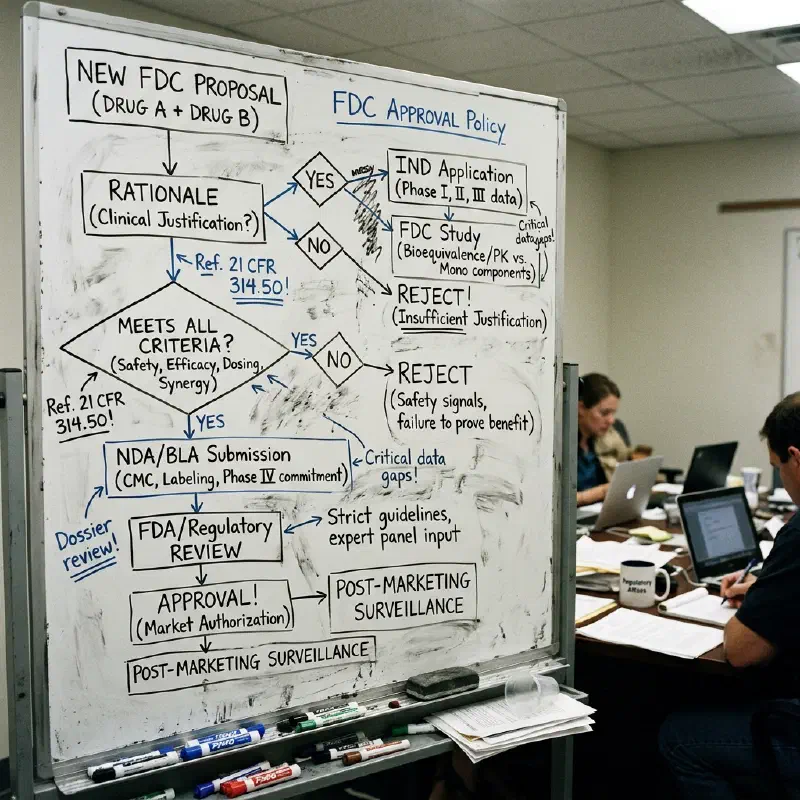
An FDC is a pharmaceutical product containing two or more APIs in fixed proportions in a single dosage unit. The rationale for requiring separate approval — rather than assuming approval from the individual ingredients’ status — is sound: a combination product may have different safety, efficacy, and drug-interaction profile from either ingredient used alone. The fixed ratio also means the prescriber cannot adjust individual doses independently, which requires evidence that the combination ratio is clinically appropriate.
Under the New Drugs and Clinical Trials Rules, 2019:
A new FDC is a drug that has not previously been approved as a combination in that exact ratio and dosage form for marketing in India.
This definition catches:
- Genuinely new combinations — molecules or ratios not previously commercialised in India
- Established molecules in new combinations — combining two long-approved APIs in a ratio that hasn’t been specifically approved
- New dosage forms of approved combinations — a tablet combination approved in a specific ratio requiring separate approval for a syrup version of the same
The Two Lists Every FDC Buyer Must Check
List 1: CDSCO FDC Approval List
CDSCO publishes a regularly updated list of FDCs and new drugs approved for marketing in India. Before committing to any combination product, check that the exact combination — same molecules, same ratio, same dosage form — appears on this list.
Access: CDSCO FDC Marketing Approvals
What to verify in the approval entry:
- Exact molecule names and strengths — not just the molecule names
- Dosage form — a tablet approval does not cover a syrup
- Approval holder — confirms the approval exists for a specific product, not generically for the combination
List 2: CDSCO Section 26A Ban Orders
Separately from the approval list, CDSCO has issued prohibition orders under Section 26A of the Drugs & Cosmetics Act banning specific FDCs. A combination could appear on neither the approval list (meaning it was never properly approved) nor the ban list (meaning CDSCO hasn’t acted against it yet) — that ambiguous middle ground is where regulatory risk is highest.
Access: CDSCO FDC Resources
A Pre-Launch FDC Evaluation Table
Use this framework to evaluate each combination product before committing artwork, packaging, or manufacturing resources:
| Check | How to Verify | Outcome |
|---|---|---|
| Appears on CDSCO FDC approval list? | Check cdsco.gov.in approval database | If Yes → proceed; If No → check IP monograph |
| Covered by IP/BP combination monograph for this exact ratio and dosage form? | Check IP 2022 or BP current edition | If Yes → generally acceptable; If No → high regulatory risk |
| Appears on any CDSCO Section 26A ban order? | Check CDSCO ban order list | If Yes → cannot market; If No → still check above |
| Is either individual molecule a New Drug (< 4 years approved in India)? | Check CDSCO new drug list | If Yes → combination needs extra scrutiny |
| Has CDSCO flagged this category for ongoing review? | Check recent CDSCO alerts and press releases | If Yes → get regulatory opinion before proceeding |
High-Volume FDC Categories and Their Regulatory Position
Lower-Risk FDC Categories (Generally Well-Established)
Paediatric fever and cough combinations — e.g., Paracetamol + Phenylephrine + Chlorpheniramine suspension — have been widely produced and marketed with long track records and IP monograph coverage for most standard combinations.
Antibiotic + anti-anaerobic combinations — e.g., Ofloxacin + Ornidazole, Metronidazole + Ofloxacin — are well-established FDCs with long prescribing history in India.
Antifungal + steroid combinations — e.g., Clotrimazole + Beclomethasone creams — have established IP and CDSCO approval track records in standard ratios.
Bronchodilator + expectorant combinations — e.g., Levosalbutamol + Ambroxol + Guaiphenesin — are high-volume, well-established prescribing combinations with established manufacturing history.
Higher-Scrutiny Categories
Analgesic FDCs — Combination analgesics, particularly those involving non-standard ratios or adding skeletal muscle relaxants to NSAID combinations, have been a primary target of FDC scrutiny. Verify approval status carefully for any non-standard analgesic combination.
Fixed-ratio anti-infective + analgesic combinations — Products combining an antibiotic with a pain molecule in fixed ratio have attracted regulatory attention across multiple enforcement cycles.
Novel nutraceutical-pharma crossovers — Combinations of approved pharmaceutical molecules with nutritional supplements in fixed ratios sit in a particularly complex regulatory space.
Products Saar Biotech Currently Manufactures in Key FDC Categories
Our manufacturing scope covers several of the well-established FDC categories:
Browse our full Suspensions Manufacturing and Syrups Manufacturing ranges for validated, commercially established formulations across approved FDC categories.
Conclusion
FDC product selection in India requires two separate affirmative checks: the combination appears on the CDSCO approval list or IP monograph for the exact ratio and dosage form, and it does not appear on any current ban order. Competitors marketing a combination is evidence of market penetration, not regulatory clearance.
The brands that navigate India’s FDC environment successfully are those who treat the regulatory check as a business decision — done early, done specifically, and done with professional support for complex combinations — rather than as paperwork to complete after the portfolio is already in production.
Ready to discuss your combination product portfolio?