
Nasal sprays occupy an unusual position in the Indian pharma contract manufacturing landscape: everyone agrees they’re a high-margin, growing category, but relatively few manufacturers actually do them well. Unlike a syrup or tablet, a nasal spray is a liquid formulation and a mechanical delivery device combined into one product — and that combination demands testing and equipment that most generalist CMOs simply don’t have in-house.
If you’re evaluating whether to add a nasal spray to your product line, here’s what actually separates a specialist manufacturer from a generalist claiming they “can do it too.”
Building out your product portfolio? See our guide to syrup and suspension manufacturing for the other major liquid oral category, or start with our Complete Third-Party Manufacturing Guide.
Why Nasal Sprays Are a Different Kind of Manufacturing

A tablet is a solid dosage form. A syrup is a liquid dosage form. A nasal spray is both a liquid formulation and a precision-engineered delivery mechanism — and the device half of that equation is where most manufacturers fall short.
Three structural reasons nasal sprays sit apart from standard liquid orals:
- Device-formulation compatibility — the pump, actuator, and nozzle must be validated together with the specific formulation, not treated as an interchangeable off-the-shelf part
- Specialized filling equipment — nasal spray filling lines differ from standard liquid-oral bottling lines and require dedicated validation
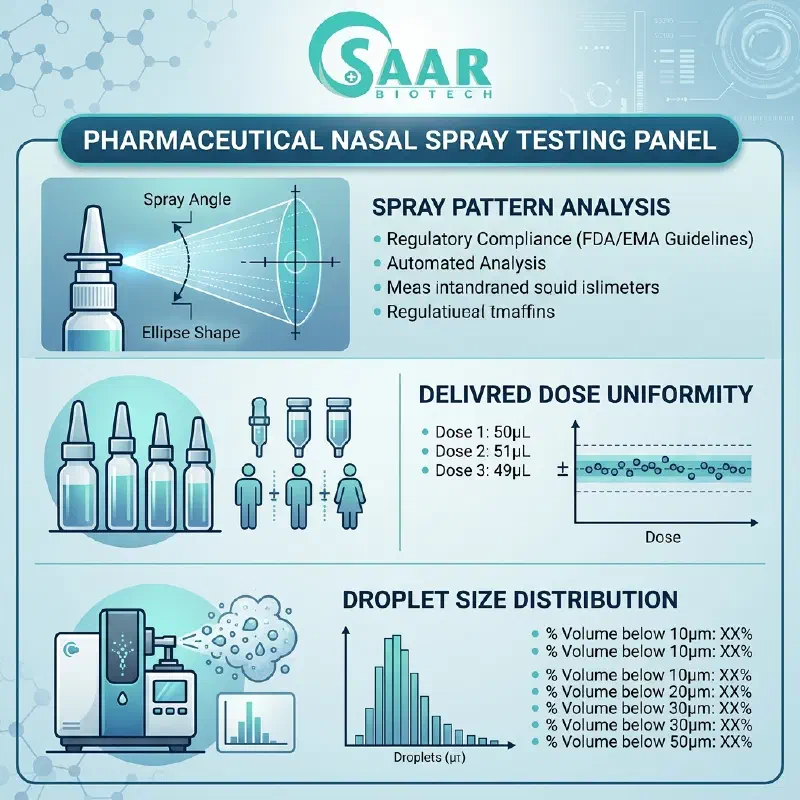
- A distinct testing panel — spray pattern, delivered dose uniformity, and droplet size are tests that a standard liquid-oral QC lab may not be equipped to run
The Market Opportunity: A Growing, Non-Seasonal Category
Allergic rhinitis, chronic congestion, and general ENT-related complaints drive consistent, year-round demand for nasal sprays — unlike cough-and-cold syrups, which see sharper seasonal peaks. For brand owners, this translates into steadier repeat-purchase revenue once a product earns physician trust.
The Testing Panel That Separates Specialists from Generalists
This is the section to bring to any manufacturer conversation. Ask specifically whether each of these is performed in-house — not outsourced to a third-party lab, which adds cost and turnaround time to every batch.
| Test | What It Confirms | Why It’s Nasal-Spray-Specific |
|---|---|---|
| Spray Pattern Analysis (USP <601>) | Consistent, symmetric spray geometry across actuations | Tablets and syrups have no equivalent test |
| Delivered Dose Uniformity | Each actuation delivers the labelled dose | Directly tied to device-formulation interaction |
| Droplet Size Distribution (laser diffraction) | Particle size critical for nasal deposition and bioavailability | Governs whether the drug reaches the intended site |
| Osmolality & Tonicity | Physiological compatibility with nasal mucosa | Prevents irritation and ensures patient comfort |
| Preservative Efficacy Testing | Anti-microbial protection across multi-dose use | Shared with liquid orals, but critical for a device that re-opens the container repeatedly |
For a deeper look at how these tests fit into a full WHO-GMP quality system, see our Quality Control Guide.
Pricing & MOQ: What’s Different From Syrups
Nasal spray economics differ from standard liquid orals in two important ways:
- Device cost is a separate, often larger line item than the liquid formulation itself — pumps and actuators are sourced from specialized vendors, and their cost and lead time vary by device type.
- MOQs run higher than a comparable syrup, because filling-line changeover and device procurement both favour larger batch runs to stay cost-efficient.
| Factor | Syrups/Suspensions | Nasal Sprays |
|---|---|---|
| Typical MOQ driver | Batch tank size | Filling line setup + device procurement |
| Device sourcing | Not applicable | Separate vendor relationship required |
| Core testing panel | Assay, dissolution, PET | Assay, spray pattern, delivered dose, droplet size, osmolality |
| Relative manufacturer availability | High (many CMOs offer this) | Lower (fewer specialists) |
Choosing the Right Nasal Spray Manufacturer: A Checklist
Before signing, confirm the following directly with any prospective partner:
- ☐ In-house spray pattern and delivered-dose-uniformity testing (not outsourced)
- ☐ Existing, validated nasal spray products on their approved formulation list
- ☐ A documented device qualification process (not just “we source pumps as needed”)
- ☐ Experience with your specific category (saline vs. decongestant vs. steroid — these are not interchangeable capabilities)
- ☐ Stability data specific to nasal spray in-use conditions, not just general liquid stability protocols
View manufacturing details for sodium-chloride-nasal-spray
How Saar Biotech Approaches Nasal Spray Manufacturing
Nasal sprays are one of the specialty dosage forms we’ve deliberately invested in, rather than treating as a bolt-on to our liquid oral capacity. Across 4 specialized manufacturing units in Baddi, our in-house QC laboratory runs the full nasal-spray-specific testing panel — spray pattern, delivered dose uniformity, droplet size, and osmolality — as a standard part of batch release, not an outsourced add-on.
For brand owners exploring this category for the first time, we work through device sourcing, formulation feasibility, and stability planning together before committing to a full commercial MOQ, so you understand the real cost and timeline before you invest.
Conclusion
Nasal sprays reward brands that treat them as the specialty category they are — not a syrup with a different cap. The manufacturers who can consistently produce validated spray pattern, delivered dose, and droplet size data are the ones worth partnering with; everyone else is likely learning on your batch. Ask the direct questions in the checklist above before you commit, and you’ll filter out the generalists quickly.
Ready to explore a nasal spray product for your brand?