
Every pharma brand owner at some point faces the question: what can I actually charge for this product? In India, that question has a regulatory answer â—€ not just a marketing one.
The National Pharmaceutical Pricing Authority’s ceiling prices, the DPCO 2013 framework, and the 10% annual cap on non-scheduled formulations are the legal boundaries within which every MRP must be set. Getting this wrong â—€ even by accident â—€ exposes a brand to NPPA compliance action. Getting it right, with a planned margin structure that works at or below the ceiling, is basic operational discipline for any pharma marketing company.
This article explains the framework at a level useful for product planning â—€ not as legal advice, but as context every brand owner should have before setting an MRP.
Pricing disclaimer: Ceiling prices change with NPPA orders. Always verify the current ceiling price for your specific formulation, strength, and pack size directly on the NPPA portal before finalising any MRP. No price mentioned in any article â—€ including this one â—€ should be used as a definitive MRP figure.
Related reading: Pharma Manufacturing Cost Trends: API, Packaging & Conversion · Complete TPM Guide · CDSCO Composition Check
The Two Pricing Buckets: Scheduled vs Non-Scheduled
The DPCO 2013 framework divides pharmaceutical formulations into two distinct regulatory categories, and your product planning should start by determining which bucket your composition falls into.
Scheduled Formulations
Formulations listed in Schedule 1 of DPCO 2013 â—€ broadly aligned with the National List of Essential Medicines â—€ have a ceiling price fixed by NPPA. This is the maximum retail price (including all taxes) at which the formulation can be sold in India.
The ceiling price is calculated by NPPA using a market-based formula (for existing molecules) or a cost-plus formula (for newer entries). It is notified in the official gazette and updated periodically.
What this means for brand planning:
- You cannot set your MRP above the ceiling price â—€ regardless of brand positioning, packaging, or market segment
- Your entire margin structure (manufacturing cost + trade margins + your own margin) must fit below the ceiling price
- NPPA revisions can compress your margin without warning â—€ build buffer
Non-Scheduled Formulations
Most pharmaceutical formulations in the Indian market are not on NLEM and are therefore non-scheduled. For these:
- There is no fixed ceiling price
- But MRP can only be increased by a maximum of 10% per year from the previous MRP
- NPPA has powers to cap non-scheduled products’ prices under para 20 of DPCO if public interest warrants
What this means for brand planning:
- You have flexibility in setting your initial MRP â—€ this is where branding and positioning have genuine pricing power
- Once your MRP is set and your products are in the market, you’re locked into the 10% annual increase limit
- Set your launch MRP thoughtfully â—€ undershooting by too much limits your ability to absorb cost increases over time
How NPPA Price Revisions Affect Running Brands
NPPA revises ceiling prices in two directions â—€ upward revisions (when input costs rise and manufacturers petition for relief) and downward revisions (when NPPA determines that market prices have moved below the notified ceiling). Both happen with some regularity.
Downward revision scenario: NPPA lowers the ceiling price on a scheduled formulation you’re selling. You must reduce MRP on new batch production immediately. Products already in the channel may have a transition period, but your billing to stockists must reflect the new price from the effective date. If your manufacturing cost has not reduced proportionately, your margin compresses.
Upward revision scenario: NPPA raises the ceiling price â—€ often in response to API cost increase petitions from industry. You may revise your MRP upward, but you’re not required to. The decision is commercial: revise if your current margins are under pressure; hold if your competitive position is better served by the existing price.
The operational implication: For scheduled formulations, monitoring NPPA orders is not optional regulatory paperwork â—€ it’s active margin management. Many brands set up basic Google Alerts for NPPA circulars or designate their regulatory consultant to track this. Missing a downward revision compliance date exposes you to inspection action.
Margin Structure Planning Under Price Control
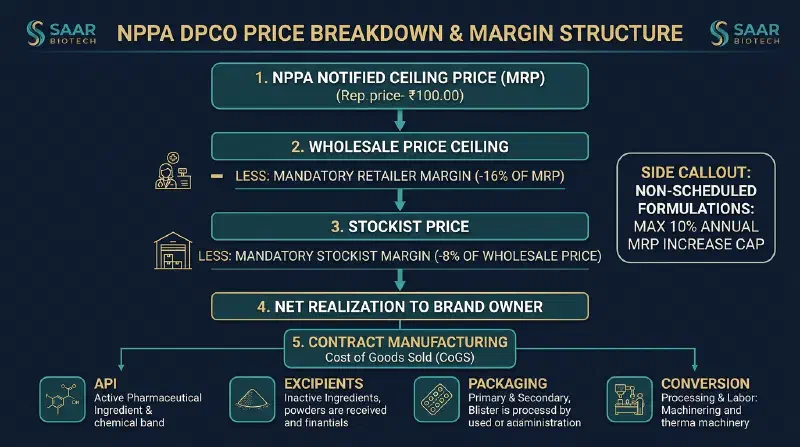
When planning the economics of a scheduled formulation, the margin model works backwards from the ceiling price:
Ceiling Price (MRP)                              = ₹100 (example ◀ verify on NPPA)
Less: Retail Margin (typically 16â—€œ20%)           = ₹18
Less: Stockist Margin (typically 8â—€œ10%)          = ₹9
Less: Distribution, freight, breakage (approx)  = ₹4
Net realisation to manufacturer/marketer         = ₹69

Less: Manufacturing cost per unit (CoGS)         = ₹35
Less: MR/promotional spend (if applicable)       = ₹15
Brand margin                                     = ₹19 per unit

This is an illustrative model only â—€ actual margins vary by product,
channel structure, and regional market.
The point of this exercise isn’t to give you a definitive margin â—€ it’s to show that for a scheduled formulation, every element of the cost structure must fit within the NPPA ceiling. There is no “charge more for quality” option when you’re in Schedule 1.
This is precisely why manufacturing cost at the right quality level matters â—€ a manufacturer who can produce the same scheduled formulation at ₹28 instead of ₹35 per unit gives you ₹7 more per unit in margin, which on 10,000 units is ₹70,000 per batch. At scale, that’s significant.

What to Actually Do Before Setting Your MRP
Step 1: Check NPPA for scheduled status. Go to nppaindia.nic.in, search your formulation. Note the ceiling price for your specific strength and pack size.
Step 2: Build the full margin model. Using your manufacturing quote, build the backwards model: ceiling price → trade margins → your cost → your margin. If the model is commercially unviable, the problem is either the product choice or the manufacturing cost ◀ not the pricing strategy.
Related planning resources: All Products by Category · Manufacturing Units — Saar Biotech & DM Pharma · Contact for Quote
For B2B manufacturing planning context: the pricing strategy.
Step 3: Verify compliance timing. Ask your regulatory consultant: is this product under any pending NPPA review? Are there petitions from industry to revise the ceiling? Entering a category where the ceiling price is expected to move within 12 months requires extra margin buffer.
Step 4: Set MRP thoughtfully for non-scheduled formulations. The 10% annual cap means your launch MRP is essentially a 5-year pricing decision. Set it at the high end of what the market will accept â—€ you can always run trade schemes to be competitive, but you cannot price above what you’ve set without a slow annual ratchet.
Conclusion
NPPA pricing is the structural context within which every pharma brand’s commercial model must operate. It’s not a regulatory technicality â—€ it’s a core variable in whether your product is economically viable. The brands that navigate price control well are those who check the ceiling price before the product brief, build their margin model before the manufacturing contract, and monitor NPPA orders as actively as they monitor sales performance.
Verify all prices on the NPPA portal before any decision. Then plan accordingly.