Packaging Trends in Indian Pharma: PET Bottles, Tubes, Pumps, Blisters & Cartons

Packaging Trends in Indian Pharma: PET Bottles, Tubes, Pumps, Blisters & Cartons

Packaging is the first physical thing a physician, pharmacist, or patient interacts with. Before the formulation is ingested, applied, or sprayed — before any clinical experience is possible — the packaging has already communicated something about the product’s quality.

Whether it communicates quality correctly depends on decisions made at the product development stage: which bottle material, which tube type, which closure, which carton weight and print finish. These decisions affect shelf life, regulatory compliance, physician perception, and ultimately, whether your product stays in the physician’s prescribing repertoire or gets compared unfavourably to the competitor’s packaging at the next MR visit.

This guide maps the packaging decisions by dosage form — not as a materials science lecture, but as practical guidance on the choices that matter commercially.

For artwork and label regulatory requirements: Pharma Product Artwork & Packaging Approval · Product Launch Timeline
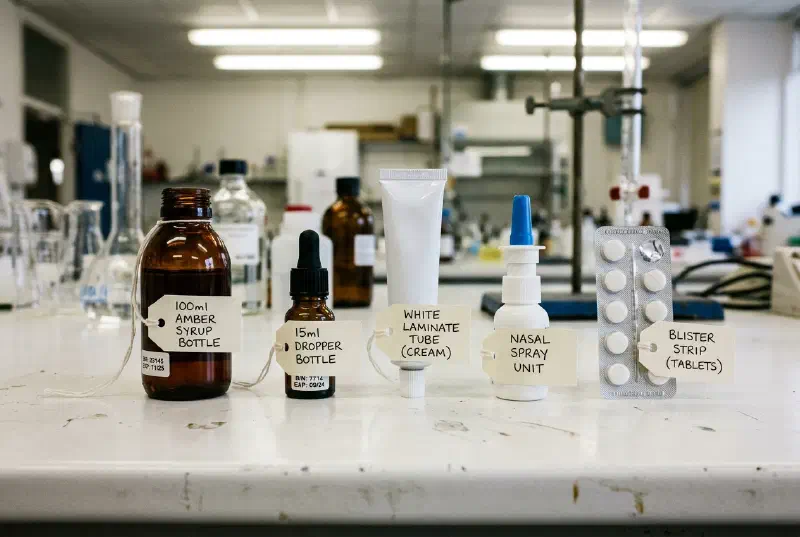
Pharmaceutical Packaging Formats Lineup \u2014 Syrup Bottle, Dropper, Cream Tube, Nasal Spray, Blister

Oral Liquids: The Bottle Decision

For syrups, suspensions, and drops, the primary packaging decision is between glass and PET, and between amber and natural/white colour.

MaterialPropertiesWhen to Use
Amber PETLight-protective, shatterproof, lightweightPhotosensitive APIs (Vitamins, some antibiotics, some antihistamines) — standard choice for most oral liquids
Natural/White HDPEOpaque, good chemical barrier, lower costProducts where light sensitivity is not a primary concern; antacid suspensions in some cases
Clear PETTransparent — product visible; lowest barrierNot recommended for pharma liquids unless formulation is verified light-stable
Amber glassSuperior barrier, premium perception, heavierPremium positioning; specific formulations where PET-compatibility is a concern
Amber glass (drops)Superior for light-sensitive dropsVitamin D3 drops, specialty supplement drops

The induction seal: Standard for all oral liquid pharma. Provides tamper evidence and reduces oxygen/moisture ingress after fill. Confirm your manufacturer’s filling line includes induction sealing.

Measuring device: Integral part of the packaging specification for volume-dosed products. Specify the type (measuring cup, oral syringe, dropper), calibrated volume, and graduation markings as part of your product brief.

Specific Bottle Sizes by Category

CategoryStandard PackMeasuring Device
Antacid suspensions170ml, 200ml amber PETMeasuring cup (30ml or 45ml)
Cough syrups (adult)100ml amber PETMeasuring cup (5ml) or 5ml spoon
Paediatric syrups60ml amber PETCalibrated oral syringe or 5ml spoon
Vitamin D3 drops15ml, 30ml amber glass or PETCalibrated tip dropper
Anti-colic drops15ml amber PETDropper tip
Alkalizer syrups100ml, 200ml amber PETMeasuring cup

Topicals: The Tube and Lotion Decisions

Topical packaging is primarily tube-based (creams, gels, ointments) or bottle-based (lotions, solutions, roll-ons).

Tube Material is a Stability Decision, Not Just a Cost Decision
The choice between PE tube and aluminium laminate tube for a topical formulation is fundamentally a stability decision. For an antifungal cream with oxygen-sensitive components, a PE tube’s moisture vapour transmission rate may allow gradual degradation over a 24-month shelf life that an aluminium laminate tube would prevent. Specify your tube material based on your formulation’s stability requirements — ask your manufacturer: “What tube material does the stability data for this product’s formulation support?” The answer should be driven by data, not by cost alone.
Tube TypeBarrierBest ForTypical MOQ
PE laminateModerateBasic moisturisers, non-sensitive topicals5,000 tubes
Aluminium-plastic laminateHighPharmaceutical creams, gels with sensitive components5,000–10,000 tubes
Aluminium collapsible tubeHighestOintments; some pharmaceutical creams5,000–10,000 tubes

Roll-on packaging (for pain gels): A roller-ball applicator in a 50ml or 100ml bottle. The roller ball is a precision component — it must roll smoothly without leaking and must not allow solvent to evaporate significantly during the product’s shelf life. Confirm your manufacturer’s roll-on filling capability specifically.

Nasal Spray Manufacturing \u2014 Pump Testing and Spray Pattern Quality Control

Nasal Sprays: The Pump and Bottle Specification

Nasal spray packaging is the most technically demanding in the product range. The pump actuator is a precision device that must be specified with:

  • Actuation volume (µl/stroke)
  • Spray pattern geometry
  • Actuation force
  • Leakage specification

Full coverage in: Nasal Spray Manufacturing — Pump Selection, Actuation & MOQ

Bottle specification for nasal sprays:

  • HDPE bottle, typically 10ml–30ml
  • Specific neck finish to accept the pump mechanism
  • Label must accommodate both product information and device instructions

Tablets and Capsules: The Blister Decision

For solid dosage forms manufactured at DM Pharma, blister packaging is standard for most retail products:

FormatStandardNotes
Alu-Alu blister10×10 strips (100 tablets per pack or 10 per strip per carton)Highest barrier; for moisture-sensitive formulations
PVC-Alu blister10×10 strips (most common)Standard for most tablets and capsules
HDPE bottles30–500 tablet bottlesHospital/institutional packs; some consumer health

Carton Quality: The Physician Impression Point

The carton is the packaging element most directly evaluated by a physician during an MR call. It’s the first thing they see, pick up, and evaluate — before any formulation experience.

Carton quality signals quality belief before clinical experience. A poorly printed, flimsy carton on a product that is clinically excellent creates a negative first impression that the formulation has to overcome. A well-printed, sturdy carton with clean typography, correct regulatory information, and appropriate finish (matte lamination is currently the premium signal in most pharma categories) creates a positive first impression.

Minimum carton specification for prescription market credibility:

  • 300 GSM+ duplex board
  • 4-colour offset printing, minimum 175 LPI screen
  • Matte or UV lamination outer surface
  • Correct mandatory label elements (all Schedule information, batch code area, storage conditions, MRP area)

Conclusion

Packaging decisions are made once at product development and live with your brand for the product’s entire commercial life. Specifying the right bottle material, tube type, measuring device, and carton quality is as important as specifying the formulation — because packaging failure affects shelf life, patient safety, and physician perception in ways that formulation excellence alone cannot compensate for.

Specify the packaging in your product brief. Ask about the materials specifically. Evaluate the samples before committing to production.

Frequently Asked Questions

Why is amber PET packaging used for most pharma liquid products in India?
Amber (brown/dark orange) PET or glass provides significant protection against UV and visible light radiation, which can degrade photosensitive pharmaceutical actives. Vitamins (Vitamin D3, Vitamin C, riboflavin), certain antibiotics, and some antacid combinations are light-sensitive — their potency decreases measurably with light exposure, affecting shelf life and ultimately the patient’s dose. Amber packaging significantly extends the effective shelf life of these formulations. For formulations where light sensitivity is not a concern (many plain antacid suspensions, saline nasal sprays), white or natural HDPE bottles are used — they have similar chemical barrier properties to amber PET without the colour-specific cost premium. Specify your bottle colour requirement in your product brief based on your formulation’s light-stability data.
What is the difference between a PE tube and a laminate tube for topical products?
PE (polyethylene) tubes are made entirely from PE — a flexible, printable, cost-effective material with moderate barrier properties. For many topical products where oxygen exposure during use is not a major stability concern (plain saline gels, many cosmetic creams), PE tubes are functionally adequate. Aluminium-plastic laminate tubes have an aluminium foil inner layer that provides significantly better barrier properties against oxygen, moisture vapour transmission, and light — making them more suitable for pharmaceutical creams and gels where formulation stability depends on limiting oxygen exposure. Laminate tubes are more expensive than PE tubes but deliver better barrier performance. For pharmaceutical-grade topicals with established stability requirements, laminate tubes are typically specified; for OTC or cosmetic-adjacent products, PE tubes may be adequate.
What is the standard carton specification for an Indian pharma product?
Standard pharma carton specification for Indian domestic market: 300–350 GSM duplex board (greyback or coated), printed on the outer white layer in 4-colour offset printing, UV varnish or matte lamination on the outer surface for protection and shelf appeal. Inner dimensions are sized to the product’s primary container with minimal movement tolerance. Mandatory carton content per Drugs & Cosmetics Rules: all the same mandatory information as the primary label (batch number reservation, MRP, storage instructions, scheduling mark if applicable) plus any patient information approved in the product registration. Carton artwork is typically produced by a specialist pharma packaging design studio familiar with regulatory requirements — the same design agency who does the bottle label should produce the carton, ensuring visual consistency.
What does 'induction sealing' mean for pharmaceutical bottles?
Induction sealing (or induction cap sealing) is a packaging process that creates a hermetic, tamper-evident foil seal on the opening of a bottle — applied after the product is filled and capped. The cap is placed on the filled bottle with a foil-lined inner seal; an induction machine passes the bottle through an electromagnetic field that heats the foil and fuses it to the bottle neck. The result is a sealed liner visible through the cap that a consumer must break to open the bottle — providing tamper evidence. Induction sealing is used for most oral liquid pharmaceutical products in India: it extends shelf life by reducing oxygen and moisture ingress, and provides the tamper-evident seal that is now effectively standard for retail pharmacy products. Confirm whether induction sealing is included in your manufacturer’s standard filling line and specify it in your product brief.
How does packaging affect the shelf appeal of a pharma product at the pharmacy?
For prescription products, pharmacy shelf appeal primarily affects the physician’s impression during an MR call (when the product is presented in its carton for evaluation) rather than a consumer’s direct purchase decision. However, for OTC products and for prescription brands where pharmacy recommendation plays a role (e.g., the pharmacist recommending a brand in the absence of a specific prescription), shelf presence matters. Packaging factors that affect pharmacy shelf appeal: label colour and legibility at shelf distance, carton print quality (high vs low quality printing is immediately visible on a shelf), bottle proportion and label positioning, and any distinctive packaging feature (coloured cap, branded measuring device, distinguishing shape). Investing in packaging quality within your manufacturing cost structure is commercially rational for OTC products and beneficial for prescription products at the physician presentation stage.
About Saar Biotech
WHO-GMP Certified
2250+ B2B Partners
240+ Products
Baddi Facility
Learn about our facility
Manufacturing Assurance

Why Choose Saar Biotech as Your Contract Manufacturing Partner?

Across every dosage form and every therapeutic area, Saar Biotech maintains the same uncompromising standards — because your brand's reputation depends on it.

WHO-GMP Certified

All dosage forms manufactured under WHO-GMP and ISO 9001:2015 in Baddi, India.

30–45 Day Turnaround

From artwork approval to first dispatch — delivered on time, India-wide.

Complete Regulatory Support

DCGI licensing, state permissions, COA issuance — handled by our team.

Segregated Lines

Dedicated Beta-Lactam and Non-Beta-Lactam manufacturing blocks for absolute purity.

240+ Approved Formulations
2250+ B2B Partners Served
Schedule M Compliant Manufacturing
30–45 Day Turnaround (Days)
Call Us
WhatsApp
Email