Paediatric medicine is the only pharmaceutical category where the end user — the patient — doesn’t make the purchase decision, doesn’t take the medicine independently, and can’t communicate clearly whether it’s working. Between the physician who prescribes and the parent who administers and the child who swallows (or doesn’t), there are at least three failure points that have nothing to do with the pharmacology of the active ingredient.
Every one of those failure points — taste rejection, inaccurate dosing, difficult administration — is a formulation design decision. And every formulation design decision that a brand makes at product development time determines whether the medicine gets taken correctly or gets poured down the drain.
This makes paediatric formulation one of the most commercially precise disciplines in Indian pharma. Get the taste, dosing, and packaging right, and a paediatric brand builds physician loyalty over years. Get any of them wrong, and the prescription gets changed at the next visit.
For the full paediatric portfolio overview: Top Paediatric Products for Third-Party Manufacturing · Oral Drops Manufacturing Guide · Taste-Masked Liquid Orals — Palatability & Repeat Sales

The Three Paediatric Prescribing Occasions and Their Compliance Challenges
Occasion 1: Acute Illness (Fever, Infection)
Products: Paracetamol suspension, Ibuprofen suspension, Azithromycin dry syrup, Cefixime suspension
Compliance challenge: Short treatment course (3–7 days), multiple doses per day, child may be ill, fevered, and non-cooperative. Taste failure in this context is immediate and reported back to the physician at the follow-up visit.
The formulation imperatives: Strong taste masking (especially for Azithromycin — bitterness is intense), appropriate viscosity (not too thin, not so thick it’s difficult to swallow), clear dosing markings or included calibrated oral syringe.
Occasion 2: Routine Supplementation (Monthly Repeats)
Products: Vitamin D3 drops, Multivitamin drops, Iron syrup, Zinc syrup
Compliance challenge: Long treatment course (months to years), no immediately visible outcome for the parent, child may resist daily administration. Parent compliance with the routine is the main variable.
The formulation imperatives: Easy dispensing (calibrated dropper that delivers consistent dose without spillage), mild taste (not intensely sweet or medicinal — for a product taken daily, mild is more sustainable than intense), amber packaging (Vitamin D3 degrades in light), clear storage instructions.
Occasion 3: Developmental Complaint (Anti-Colic, Digestive, Appetite)
Products: Dill + Fennel + Simethicone drops, Enzyme drops, Cyproheptadine + Tricholine Citrate syrup
Compliance challenge: Outcome is subjective (is the colic better? is appetite improved?), parent is often stressed (colic context especially), and product efficacy is difficult to separate from natural developmental resolution.
The formulation imperatives: Rapid palatability (parent will judge the product on first dose), easy dispensing (stressed parents need a foolproof device), mild flavour that the infant or toddler accepts, appropriate viscosity.

The Dosing Device: The Most Under-Specified Element
Most paediatric product briefs specify “include measuring device.” This is insufficient.
What a properly specified dosing device looks like:
DOSING DEVICE SPECIFICATION (from product brief)

For Vitamin D3 Drops (400 IU/drop at 40µl/drop):
  Device: Calibrated tip dropper
  Material: LDPE or HDPE, amber
  Calibration: 40 ± 4µl per drop (validated, held vertically, 25°C)
  Validation: Dropper calibration report from manufacturer included in batch documentation

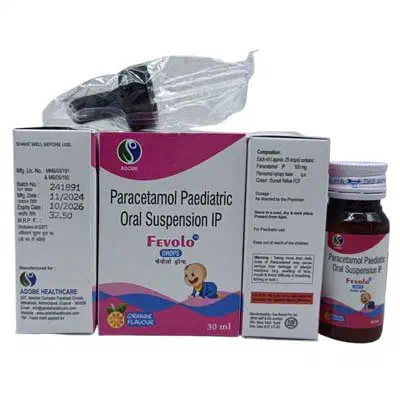
For Paracetamol 125mg/5ml Suspension:
  Device: Calibrated oral syringe, 5ml capacity
  Markings: 0.5ml intervals, clearly moulded (not printed)
  Included in: Inside-carton, separately sealed

For Azithromycin Dry Syrup 200mg/5ml:
  Device: Measuring cup, 5ml or 10ml
  Material: PP, food grade
  Markings: 2.5ml and 5ml minimum
  Position: Inside reconstituted bottle cap or separate in carton
The difference between a specified device and an unspecified device is the difference between a product that reliably delivers the intended dose and one that doesn’t — regardless of what’s printed on the label.
Packaging for Two Audiences
Paediatric product packaging must work for both the physician (who evaluates it in a clinical setting during an MR presentation) and the parent (who uses it at home under conditions of stress, fatigue, and often dim lighting).
What physicians look for:
- Clear composition on the label
- GMP credentials visible on the carton
- Professional, clinical-quality artwork
- Dose by age and weight clearly stated
What parents need:
- Tamper-evident, but openable without tools
- Bottle markings in clear units (ml) with large, legible font
- Product recognisable by sight (consistent across doses)
- Storage instruction clear and unambiguous
- Instructions for administration simple enough to follow at 2am
The paediatric brand that fails to design for the parent — even while designing for the physician — produces a product that doesn’t get used correctly, doesn’t achieve its clinical outcome, and doesn’t get represcribed.
Conclusion
Paediatric formulation demand in India rewards brands who invest in the details that compliance science demands: taste masking that makes the medicine acceptable, dosing devices that make dose accuracy achievable, and packaging that makes administration safe and consistent. These are not pharmaceutical marketing decisions — they are clinical design decisions with commercial consequences.
The brands that get these three right build physician loyalty through patient outcomes. The ones that don’t get changed at the next visit.