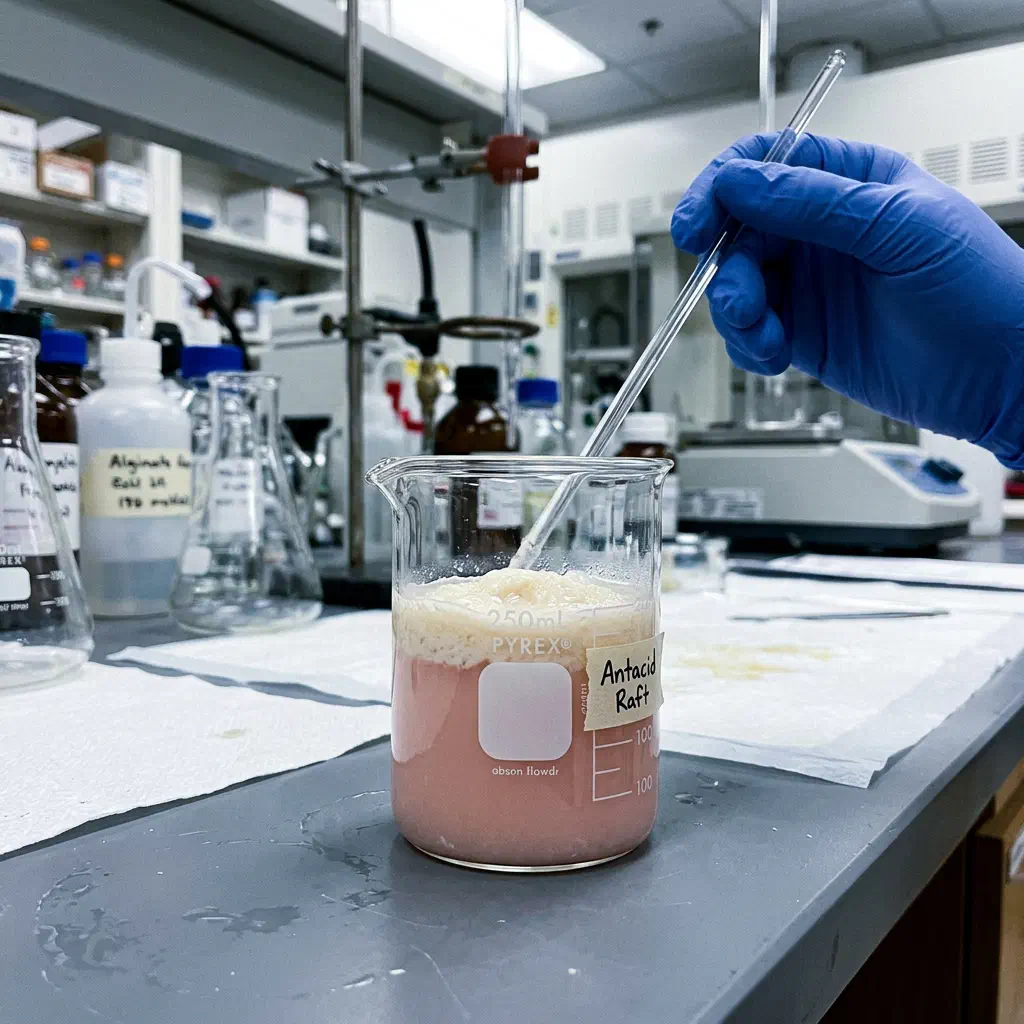
Most antacid suspensions work the same simple way: neutralize acid, feel better. This formulation is different. Combining sodium alginate with sodium bicarbonate and calcium carbonate creates a raft-forming suspension — a mechanism that’s mechanically more sophisticated than a standard antacid, and correspondingly more demanding to manufacture correctly.
If you’re evaluating this product for your portfolio, here’s what actually happens inside the formulation, why it’s harder to get right than it looks, and what to ask a prospective manufacturer.
New to suspension manufacturing generally? Start with our broader Syrup & Suspension Manufacturing Guide for MOQ, pricing, and process fundamentals before diving into this formulation-specific detail.
The Mechanism: Why “Raft Formation” Isn’t Just Marketing Language
Standard antacids work through simple acid neutralization — the antacid reacts with stomach acid, and the reaction products pass through the digestive system. This combination does something additional.
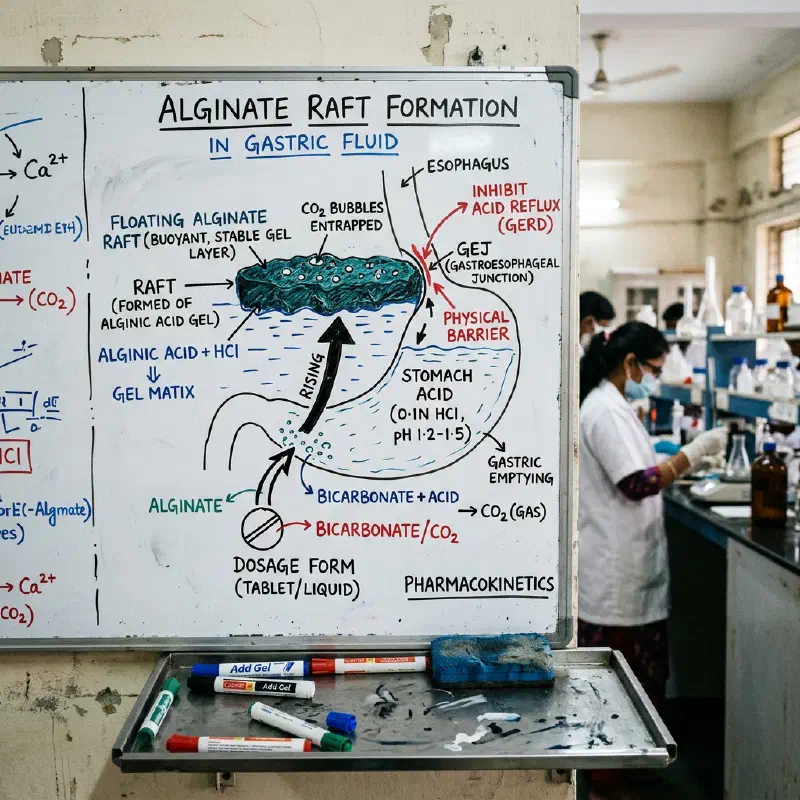
When sodium alginate reaches the stomach, it reacts with gastric acid and available calcium ions to form a cohesive gel structure. Simultaneously, sodium bicarbonate and calcium carbonate react with acid to release carbon dioxide, and that CO2 becomes trapped within the forming alginate gel — creating a low-density, foam-like layer that floats to the top of the stomach contents. This “raft” sits above the gastric pool and physically impedes reflux into the oesophagus.
The Core Manufacturing Challenge: Controlled Reactivity
The same chemistry that makes this formulation work in the stomach is exactly what makes it tricky to manufacture and store. Sodium bicarbonate and calcium carbonate are both acid-reactive by design — which means manufacturing has to actively prevent premature reaction during production and shelf life, while preserving full reactivity for when the patient actually takes the dose.
Three specific technical challenges define this formulation:
| Challenge | What Can Go Wrong | Why It Matters |
|---|---|---|
| Premature CO2 generation | Trace acid contamination or pH drift during manufacture can trigger early gas release | Leads to bottle pressure buildup, inconsistent fill volumes, or product loss |
| Viscosity instability | Alginate concentration or processing shear can alter viscosity over shelf life | Affects both raft formation efficacy and pourability/dosing accuracy |
| Sedimentation and redispersibility | Calcium carbonate, being insoluble, will settle over time | Requires validated “shake well” redispersion — an uneven shake means an uneven dose |
Manufacturing Process: What’s Different From a Standard Suspension
The broad development flow follows the same structure as any suspension — brief, prototype, stability, scale-up — but with formulation-specific steps layered in:
- Formulation Brief & Reference Matching (Week 1–2) — Matching alginate grade/molecular weight to target viscosity and raft strength
- Prototype Development (Week 2–5) — Iterative viscosity and pH balancing to control reactivity without compromising shelf stability
- Raft Formation / Gel Strength Testing (Week 4–6) — In-vitro evaluation confirming the formulation forms a cohesive, floating raft under simulated gastric conditions
- Sedimentation & Redispersibility Testing (Week 4–6) — Confirming calcium carbonate settling doesn’t compromise dose uniformity after standard shaking
- Stability Studies (Month 2+) — Accelerated and real-time, with particular attention to viscosity drift and any premature gas generation in sealed containers
- Pilot Batch & Scale-Up (Month 3–4)
- Commercial Batch 1 (Month 4–6 for a new formulation; 30–45 working days if working from an already-validated formulation)
View manufacturing details for sodium-alginate-antacid-suspension
Regulatory & Quality Considerations
This formulation typically falls under standard OTC/Schedule classification for antacid products in India, but brand owners should confirm exact scheduling with their manufacturer’s regulatory team, as formulation-specific strength and combination can affect classification. From a quality standpoint, review our full Quality Control Guide for how WHO-GMP batch release, COA issuance, and stability protocols apply — this formulation simply adds the raft-specific and viscosity-specific tests described above on top of that standard framework.
Why This Is a Strong Portfolio Addition
Beyond the manufacturing complexity, this category has real commercial durability:
- Chronic, recurring condition — GERD and acid reflux are not one-time purchases; patients on this therapy tend to refill regularly
- Differentiated mechanism — the raft-forming story gives your brand a genuine clinical differentiation point versus a generic antacid, useful for medical representative detailing
- Format flexibility — sugar-free and flavoured variants (peppermint, aniseed) broaden your addressable patient base without requiring a separate formulation from scratch
How Saar Biotech Manufactures This Formulation
Raft-forming suspensions require formulation and QC discipline beyond a standard antacid, and it’s a capability we’ve built deliberately rather than treated as a variation of any other suspension. Across our WHO-GMP certified units in Baddi, our development team validates raft formation and gel strength as part of standard formulation work — not an optional add-on — and our QC laboratory runs the viscosity and redispersibility testing this category demands as part of routine batch release.
Conclusion
A sodium alginate, sodium bicarbonate, and calcium carbonate suspension looks, on paper, like just another antacid formulation. In practice, it’s a raft-forming mechanism that demands real formulation expertise — controlled reactivity, viscosity stability, and functional (not just chemical) validation. For a manufacturer that treats it with that level of specificity, it’s also one of the more durable, high-repeat-purchase products a liquid oral portfolio can carry.
Interested in adding this formulation to your product line?