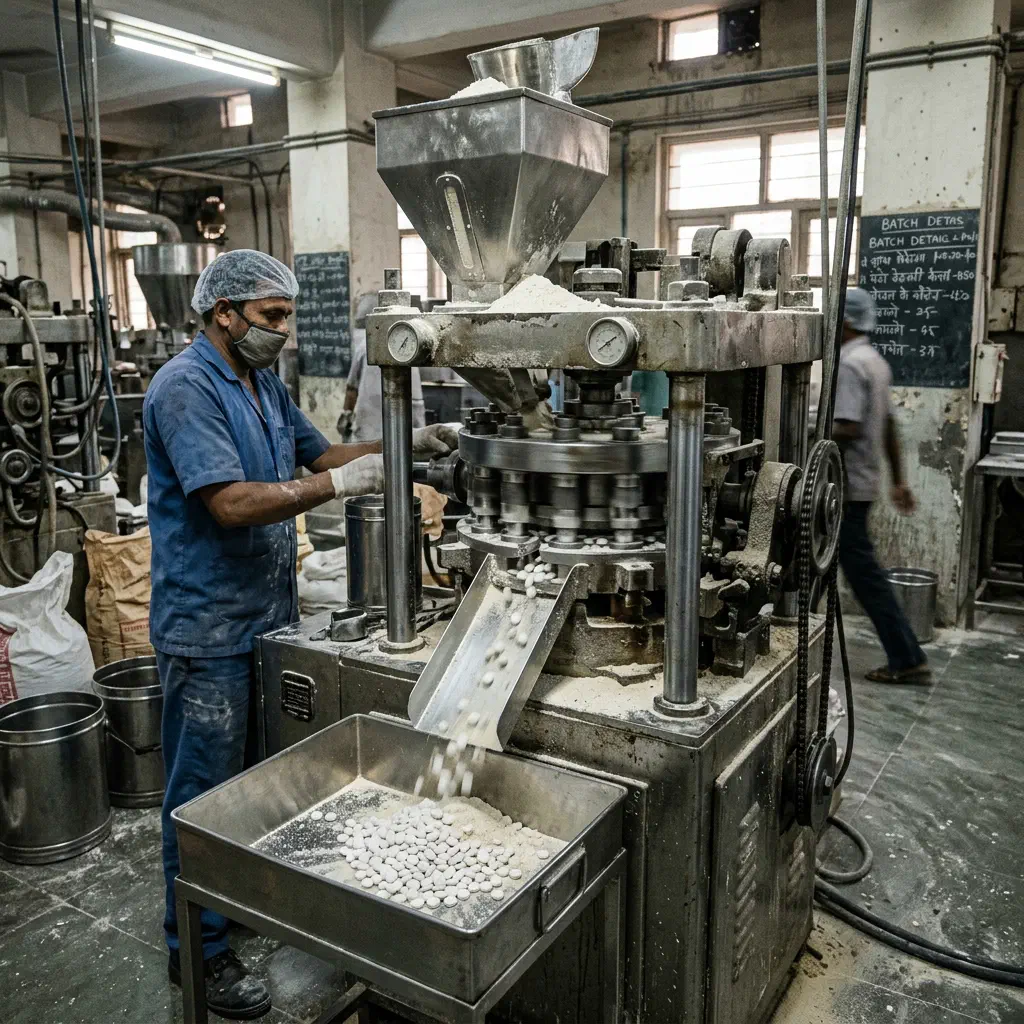
Most pharma brand owners think of Saar Biotech first for liquid orals — syrups, suspensions, nasal sprays. That’s the right association: it’s where the group’s manufacturing depth is deepest. But many of those same brands also carry tablets and capsules, and sourcing solid dosage forms from a second, unrelated manufacturer means managing two quality relationships, two document trails, and two production timelines.
DM Pharma exists to close that gap. As a dedicated solid dosage unit within the Saar Biotech group in Baddi, it handles tablets, capsules, and solid nutraceutical formulations — so brands already working with the group for liquids can extend their portfolio without a new manufacturer relationship.
Building a complete product portfolio?
See our Third-Party Manufacturing Guide for regulatory fundamentals, our Syrup & Suspension Guide for liquid oral complements, or browse our full product categories.
What DM Pharma Manufactures
DM Pharma’s manufacturing scope covers solid oral dosage forms across pharmaceutical and nutraceutical categories:
| Category | Formats Available |
|---|---|
| Pharmaceutical tablets | Uncoated, film-coated, sugar-coated, dispersible, extended-release |
| Pharmaceutical capsules | Hard gelatin (HGC) and HPMC vegetarian capsules |
| Nutraceutical tablets | Multivitamin, mineral, herbal, antioxidant combinations |
| Nutraceutical capsules | Omega-3, probiotic, herbal and botanical formulations |
| Cosmetic/wellness solids | Hair, skin and nail supplement formulations |
This breadth is significant for a brand building a product portfolio — it means a single manufacturing relationship can supply both the cough syrup and the antibiotic tablet in a doctor’s prescription pad, with coordinated batch documentation.
Tablet vs Capsule: Which Format to Choose
The decision between tablet and capsule isn’t just aesthetic — it has real implications for manufacturing cost, API suitability, and patient acceptability.
| Factor | Tablet | Capsule |
|---|---|---|
| Manufacturing cost | Generally lower per unit at scale | Higher per unit due to capsule shell cost |
| API suitability | Well-suited for high-dose actives; compressible APIs | Better for hygroscopic, light-sensitive, or unstable APIs; APIs that can’t be compressed |
| Patient acceptability | Familiar, easy to split (if uncoated/scored) | Easier to swallow than large tablets; no bitter taste if properly filled |
| Coating options | Film, sugar, enteric-coated variants available | Delayed-release and enteric-coated capsules available |
| Brand positioning | Broad market familiarity | Premium or specialist positioning |
Coating Options — More Than an Aesthetic Choice
Coating choice affects manufacturing time, per-unit cost, patient experience, and often physician prescription confidence. Here’s how the three main options compare in a practical context:
Uncoated tablets are the fastest and cheapest to produce — no coating pan, no coating suspension preparation, no additional drying time. They’re suitable for APIs that don’t require taste-masking and where shelf appeal isn’t the primary competitive lever. Certain generic vitamin tablets and cost-sensitive commodity molecules are commonly marketed uncoated.
Film-coated tablets add a thin polymer film (typically HPMC or Eudragit-based) that improves appearance, masks bitterness, protects the core from humidity, and gives the product a polished, premium look. Film coating is the standard choice for most modern branded pharmaceutical tablets — it improves patient compliance and physician confidence at a relatively modest cost premium.
Sugar-coated tablets apply a heavier sucrose-based coat over multiple coating stages — a more labour-intensive process that produces a rounded, glossy tablet with excellent taste-masking. The format is still used for certain antiparasitic drugs, enzyme preparations, and some traditional formulations, but it has largely been replaced by film coating in newer products.
Blister vs Strip Packing: The Decision That Affects Your Retail Position
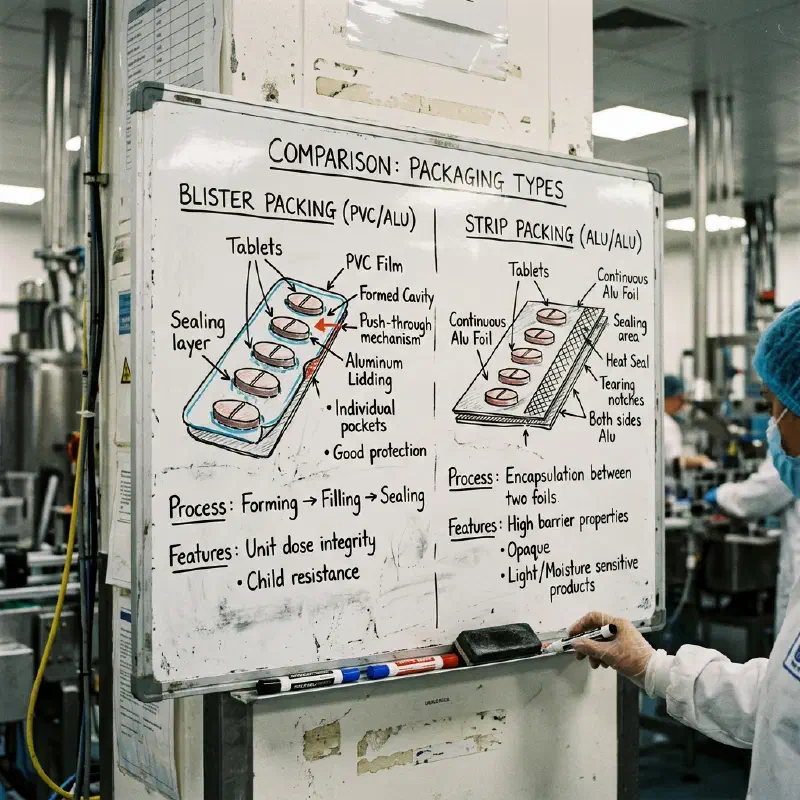
Packing format is a decision buyers often make late — and then can’t change without reworking artwork. Understanding the difference before you brief your manufacturer avoids a common source of delay.
Blister packing thermoforms a PVC or PVC/PVDC cavity for each individual tablet, sealed with aluminium foil. Each tablet is individually protected; the branded artwork is printed on the foil; pharmacist and patient can clearly see and count tablets. Blister packing is the preferred format for branded products competing on quality perception and physician recommendation. PVC/PVDC combinations offer better moisture and oxygen barrier than plain PVC, which matters for moisture-sensitive APIs.
Strip packing seals tablets between two layers of foil or foil-polymer laminate in a continuous strip. It’s faster to produce and lower-cost per unit than blister packing, but doesn’t offer individual cavity protection. Strip packing is common for cost-competitive generics, where per-unit cost is the primary driver and the product is not being positioned on premium quality signals.
| Pack Feature | Blister Pack | Strip Pack |
|---|---|---|
| Per-tablet protection | Individual cavity per tablet | Shared seal between tablets |
| Cost per pack | Higher | Lower |
| Artwork surface | Foil top — print quality visible at point of sale | Limited print surface |
| Moisture protection | PVC/PVDC option for sensitive APIs | Adequate for standard molecules |
| Preferred for | Branded therapeutic products | Commodity generics on price |
Building Your Product Brief for Solid Dosage Enquiry
The quality of your first enquiry determines how quickly you get an accurate quote. For tablets and capsules, a complete brief contains:
SOLID DOSAGE MANUFACTURING ENQUIRY — DM PHARMA

PRODUCT DETAILS
Product name: [your brand name]
Composition: [active API and strength, e.g., Paracetamol 500mg + Caffeine 30mg]
Dosage form: Tablet / Capsule (hard gelatin / HPMC)
Coating: Uncoated / Film-coated / Sugar-coated
Pack style: Blister (10 tablets per strip, 10 strips per box) / Strip / Bottle
Pack size: [e.g., 10×10 blister]

QUANTITY
First batch quantity: [number of tablets / number of packs]
Expected repeat order frequency: [monthly / quarterly / seasonal]

REGULATORY STATUS
Is the composition approved? [Yes — existing approved molecule / Yes — FDC / Need to verify]
Artwork status: [Design ready / In progress / Not started]
Drug license status: [Obtained / In process / Need guidance]

ADDITIONAL NOTES
[Any special requirements: extended-release, dispersible, specific excipient preferences]
Sending a brief in this format — even via WhatsApp or email — saves 3–5 days of back-and-forth before your feasibility call and results in a more accurate first quote.
How DM Pharma Fits Into Your Portfolio Strategy
For brands building a complete product range, the combination of Saar Biotech’s liquid oral and nasal spray capability with DM Pharma’s solid dosage expertise means a single partnership covers the majority of a typical pharma marketing company’s product portfolio.
A doctor writing a paediatric fever protocol might prescribe a suspension and a tablet. A dermatology brand might need a topical gel and an antifungal capsule. Sourcing both from a coordinated manufacturer group means fewer quality relationships to manage, shared regulatory understanding, and production timelines that can be coordinated across dosage forms.
Related category pages:
- Syrups Manufacturing — liquid oral complements to your solid dosage range
- Suspensions Manufacturing — paediatric and GI suspensions
- Topicals Manufacturing — dermatology creams, gels, ointments
- Oral Drops Manufacturing — paediatric drops and nutraceutical shots
- Manufacturing Unit: DM Pharma — facility profile
- Manufacturing Unit: Saar Biotech — liquid oral facility profile
Conclusion
Tablets and capsules are the backbone of most pharma product portfolios — and DM Pharma provides that solid dosage capability within the Saar Biotech group’s manufacturing ecosystem in Baddi. Whether you’re adding a tablet to complement an existing liquid oral line or building a new solid dosage portfolio from scratch, the starting point is a clear product brief: composition, strength, coating, pack style, and expected volume.
Ready to explore a tablet or capsule formulation?