Case studies in pharma manufacturing tend to be vague — brand names withheld, timelines approximate, numbers generic. This one is meant to be more useful than that. What follows is a realistic, step-by-step account of how a Vitamin D3 nano-shot product moved from initial brief to commercial dispatch in 45 working days, based on a product launch through Saar Biotech’s manufacturing facility in Baddi. Client identifiers are anonymised; timelines are real for this specific formulation and readiness level.
The goal isn’t to make this sound faster or simpler than it actually is — it’s to give a brand owner considering this product category a concrete sense of what the process looks like operationally, so they can plan accordingly.
Not yet familiar with the nutraceutical manufacturing category?
Start with our Nutraceutical & Vitamin D3 Manufacturing Guide for regulatory and formulation fundamentals, and the Oral Drops Manufacturing category page for the full range.
The Product Brief
The client in this case was an established pharma marketing company already active in oral liquids — syrups and antibiotic suspensions — who wanted to add a nutraceutical line to capture the Vitamin D3 prescribing happening within their existing physician network.
Their initial brief was clear:
- Product: Cholecalciferol (Vitamin D3) nano-shot
- Strength: 60,000 IU per unit dose
- Format: 15ml single-serve ampoule, shelf-stable (no refrigeration requirement)
- Pack: 10 ampoules per box
- Target first batch: 5,000 boxes (50,000 ampoules)
- Artwork: 80% ready — pending manufacturer’s label requirements
- Regulatory: FSSAI Central license held by manufacturing entity; client needed guidance on brand-owner FSSAI registration
- Target dispatch: Within 6 weeks
This brief was clear in the right places and had one specific gap — artwork — which we knew would determine whether the 45-working-day target was achievable.
Why Vitamin D3 Nano-Shot Was the Right Starting Product
Before getting into the manufacturing timeline, it’s worth noting why the client’s product choice was strategically sound — not as a pat on the back, but because the reasons generalize usefully to other brand owners considering a nutraceutical entry.
The demand is real and non-seasonal. Vitamin D deficiency across the Indian population is extensively documented — affecting office workers, homemakers, elderly patients, and increasingly recognised in children. Unlike cold-season supplements, D3 prescribing happens year-round across specialties: orthopaedics, gynaecology, general medicine, paediatrics.
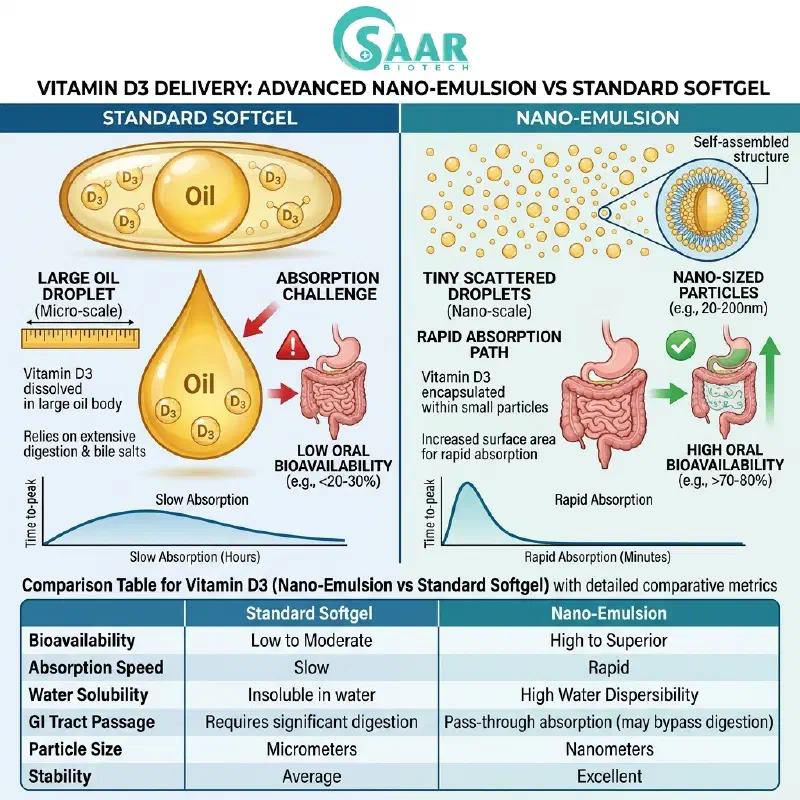
The nano-shot format is a genuine differentiator. The client was not entering a crowded softgel market — they were entering a format that most physicians associate with premium, fast-acting supplementation. The 60,000 IU single-dose protocol (weekly or bi-weekly dosing) is widely prescribed and familiar to physicians; the nano-shot just delivers it more conveniently and with a differentiated absorption story.
The regulatory path was shorter than pharma. FSSAI nutraceutical licensing is a faster process than CDSCO drug licensing — the client could move from regulatory compliance to commercial launch without the 6-12 month drug license timeline.
The Timeline: Week by Week
Week 1: Contract, Feasibility Confirmation & Artwork Brief
Days 1–3: Contract execution and advance payment confirmation. Simultaneously, our regulatory team shared FSSAI label requirements for nutraceuticals — specifically the mandatory declarations, permitted health claims, and required label format under the Health Supplements regulations — so the client’s design agency could finalise artwork correctly in one round rather than going through multiple correction cycles.
Days 4–5: Formulation feasibility confirmed. For our Cholecalciferol 60,000 IU nano-shot, stability data and particle size characterisation already exist — no new development required. Raw material quantities calculated and API + ampoule procurement orders placed with existing qualified vendors.
The critical early decision: The client committed to providing artwork approval within 10 working days from artwork brief. This was the variable that made the 45-day timeline achievable. Artwork delays are the single most common reason a 45-day timeline extends to 75 days.
Weeks 2–3: Artwork Approval & Raw Material Procurement
Days 6–15: The client’s design agency submitted ampoule label artwork on Day 8. One revision round for label area dimensions and mandatory FSSAI declaration placement. Final artwork approved on Day 14.
Simultaneously, API (Cholecalciferol powder, high-purity pharmaceutical grade) and ampoule components (15ml clear ampoules, tamper-evident caps) were received from our AVL vendors and moved to incoming material quarantine.
Week 3–4: Raw Material Testing & Production Preparation
Days 15–20: Incoming material QC testing — API identity, assay, and potency confirmation by HPLC. Ampoule visual inspection, dimensional confirmation, and leak testing. All materials passed specifications and received ‘Released’ status.
Days 18–22: Batch manufacturing record (BMR) prepared, equipment cleaned and documented, production slot allocated in the manufacturing schedule.
Week 4–5: Manufacturing, Filling & In-Process QC
Days 22–26: Manufacturing — nano-emulsion preparation using validated homogenisation parameters. In-process checks at every critical step:
- Droplet size after homogenisation (target: 20–200nm, measured by dynamic light scattering)
- pH (stability-critical for cholecalciferol)
- Clarity and visual appearance
- API assay on intermediate bulk
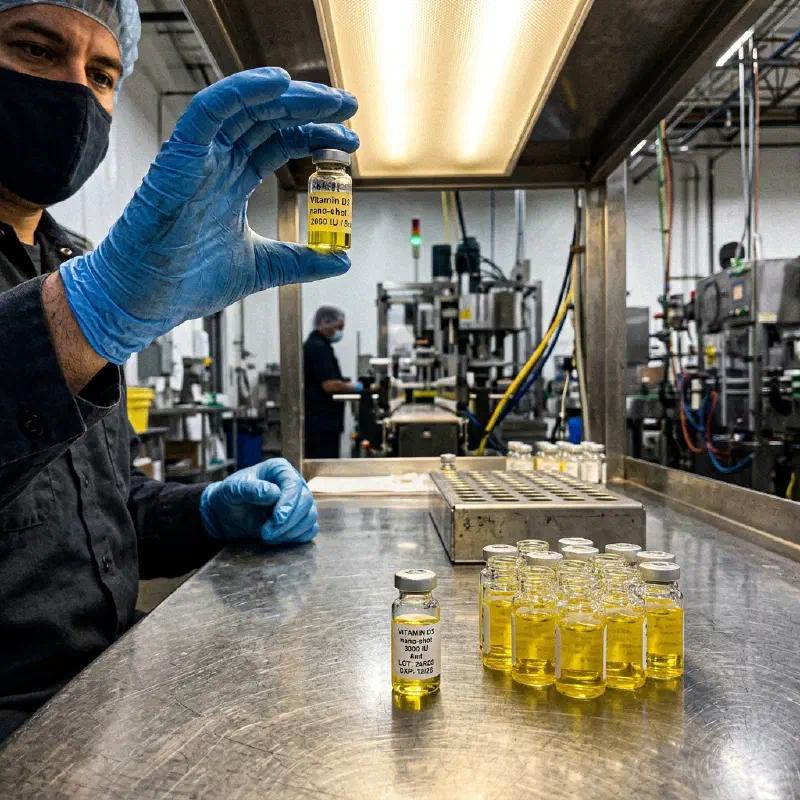
Days 26–29: Ampoule filling and sealing. Fill volume uniformity checked at 15-minute intervals throughout the filling run. Seals verified by dye-ingress testing on randomly selected ampoules.
Days 29–31: Secondary packaging — ampoule boxing (10 per box), outer carton labelling, batch and expiry coding.
Week 5–6: Finished Product QC & Batch Release
Days 31–38: Full finished product QC panel:
- Assay (Cholecalciferol by HPLC) — result: 61,200 IU/15ml, within specification (95–115% of label claim)
- pH: 6.2 (specification: 6.0–7.0)
- Particle size: mean 47nm, distribution confirmed within nano-emulsion specification
- Microbial limits: TAMC and TYMC within specification, pathogens absent
- Fill volume uniformity: all units within ±2% of nominal fill
- Appearance: clear, pale yellow solution without visible particles
Day 39: Quality Control Manager review and Qualified Person sign-off on batch release.
Day 43: Dispatch
First commercial batch dispatched to the client’s central warehouse — 5,000 boxes, 50,000 ampoules. Dispatch documentation: COA, delivery challan, invoice, FSSAI declaration, transport temperature record.
Total: 43 working days from contract execution to dispatch.
What Made This Timeline Achievable
Two factors made 43 working days possible:
Artwork approved in 14 working days. This is the single most variable element. Clients who come with artwork already 90%+ ready and make decisions quickly add 2–3 weeks to available production time. Clients who treat artwork as something to finalise after manufacturing starts routinely delay themselves by 3–4 weeks.
Formulation already validated. No development time. No new stability study. No particle size optimisation. The formulation existed, the batch record existed, and the raw material sourcing was already qualified.
Lessons for Brand Owners Launching Their First Nutraceutical
Brief your designer before you brief your manufacturer. The FSSAI label requirements for nutraceuticals — mandatory declarations, claim restrictions, font size rules — are specific and not interchangeable with pharma drug label requirements. Your designer needs this briefing before the first draft, not after three revision rounds.
Nano-emulsion claims require particle size data. If a manufacturer says the product is a nano-emulsion but can’t produce a dynamic light scattering report showing droplet size distribution, it’s not a nano-emulsion — it’s a standard liquid suspension with a label claim. Ask for the data specifically.
MOQ of 5,000 units is the practical starting point for ampoule formats. Below this, per-unit ampoule and production economics become unfavourable. Plan a first batch of 5,000 ampoules minimum, and have a sense of your second-order volume before your first dispatch — it affects production scheduling.
Conclusion
A Vitamin D3 nano-shot launch in 43 working days is not marketing language — it’s the operational result of a validated formulation, a clear product brief, and artwork approved without delay. The case study is meant to show you what the process actually looks like week by week, so you can plan your own launch with realistic expectations rather than optimistic assumptions.
Ready to explore a Vitamin D3 nano-shot for your nutraceutical portfolio?
Browse the full Oral Drops & Nutraceutical Shots range for all available liquid nutraceutical formats.