
What is IP 2026? India's New Pharmacopoeia Explained for Pharma Brand Owners

What is IP 2026? India's New Pharmacopoeia Explained for Pharma Brand Owners

If you’ve read any of our regulatory content, you’ve seen “IP 2026” mentioned as a compliance reference point — but we’ve never actually explained what it is. Given how directly it affects what your contract manufacturer can and must do, it’s worth a dedicated, plain-English breakdown.

New to pharma regulatory terminology generally? This pairs well with our Quality Control Guide, which covers WHO-GMP, batch release, and testing protocols more broadly.

What the Indian Pharmacopoeia Actually Is

Indian Pharmacopoeia Reference Books

The Indian Pharmacopoeia (IP) is India’s official book of drug standards, published by the Indian Pharmacopoeia Commission (IPC) on behalf of the Ministry of Health & Family Welfare. It isn’t a reference document you can choose to follow — it’s legally enforceable under the Drugs and Cosmetics Act, 1940. Every drug manufactured or marketed in India has to meet the identity, purity, and quality standards laid out in the current edition.

Why This Matters Beyond Compliance Paperwork
When a new IP edition is released, it isn’t just an administrative update. Manufacturers need to review their existing formulations and analytical methods against the new monographs — sometimes requiring updated testing methods, revised specifications, or fresh documentation before a product can continue commercial release.

IP 2026: What Changed in the 10th Edition

IP 2026 was officially released on January 2, 2026, by Union Health Minister J.P. Nadda at Dr. Ambedkar International Centre in New Delhi, marking the 10th edition of India’s pharmacopoeia. Two changes are worth understanding specifically:

What ChangedThe DetailWhy It Matters
New Monographs121 new monographs added, bringing the total to 3,340Broader coverage means more drug substances and dosage forms now have official, enforceable Indian standards
Blood Component Standards20 blood component monographs added for the first time, covering transfusion medicineReflects the Drugs and Cosmetics (Second Amendment) Rules, 2020 — a first-time formal quality framework for this category

This isn’t a minor update. Going from the 9th to the 10th edition represents a meaningful expansion of the standards Indian manufacturers are held to, alongside a first-time formal quality framework for an entirely new drug category.

Why India’s Regulatory Credibility Is Rising

Alongside the IP 2026 release, another figure is worth noting for anyone evaluating the credibility of Indian pharmaceutical manufacturing broadly: India’s contribution to the World Health Organization’s global pharmacovigilance database has risen from 123rd globally during 2009–2014 to 8th worldwide as of 2025. That’s a significant jump in how actively and rigorously India tracks and reports drug safety data internationally — and it’s a direct signal of the maturing regulatory ecosystem that IP 2026 is part of.

What This Means for International Buyers
If you’re a brand owner exporting from India, this regulatory trajectory matters. The Indian Pharmacopoeia is actively harmonised with the European, Japanese, and US Pharmacopoeias through the Pharmacopoeial Discussion Group, and its general requirements align with International Council for Harmonisation (ICH) standards — narrowing the gap between what’s acceptable domestically and what export markets expect.

IP 2026 vs. WHO-GMP: A Common Point of Confusion

Brand owners often use “WHO-GMP” and “Indian Pharmacopoeia” interchangeably, but they govern different things entirely:

WHO-GMP (Schedule M)Indian Pharmacopoeia (IP 2026)
GovernsHow a drug is manufactured — process, hygiene, documentationWhat standard the finished drug must meet — purity, identity, assay
Answers the question“Was this batch made correctly?”“Does this batch meet the required specification?”
Where it livesFacility SOPs, batch manufacturing recordsProduct specifications, analytical test methods

A compliant manufacturer needs both working together: GMP-compliant processes producing IP-compliant products. Neither one substitutes for the other.
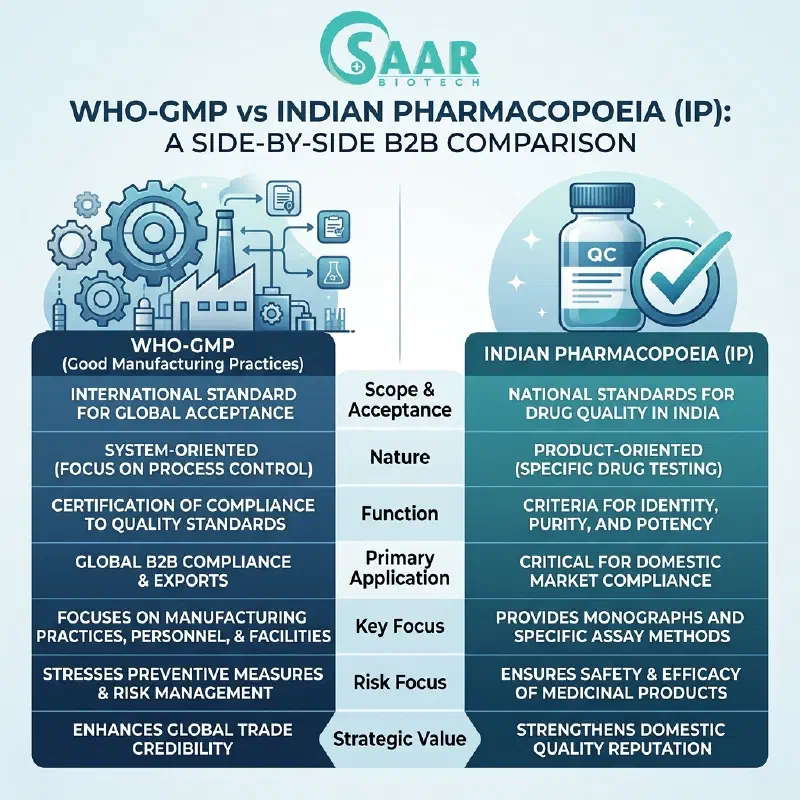
Infographic comparing WHO-GMP vs Indian Pharmacopoeia standards

What This Means Practically for Your Brand

If you’re working with (or evaluating) a third-party manufacturer, IP 2026 gives you a concrete, specific question to ask:

  • “Have you reviewed our formulation’s specifications against the IP 2026 monographs?” — A manufacturer actively managing this transition should be able to answer this directly, not vaguely reference “staying compliant.”
  • “Has any analytical method changed for our product under the new edition?” — Relevant if your product falls under a monograph that was revised or newly added.
A Red Flag Worth Watching For
If a manufacturer can’t tell you whether IP 2026 affects your specific formulation, that’s a sign their regulatory affairs function isn’t actively tracking pharmacopoeial updates — a real quality-management gap, not just a communication issue.

How Saar Biotech Manages Pharmacopoeial Updates

Our regulatory affairs team actively reviews new IP editions against our full formulation portfolio, updating specifications and analytical methods where required rather than waiting for an inspection to surface a gap. This is part of the same quality discipline covered in our Quality Control Guide — pharmacopoeial compliance isn’t a one-time certification, it’s an ongoing process.

Conclusion

IP 2026 is more than a regulatory footnote — it’s the current, legally binding quality standard your product has to meet, with 121 new monographs and a first-time blood component framework that didn’t exist in the prior edition. Understanding what it actually covers, and how it differs from WHO-GMP, gives you a sharper set of questions to ask any manufacturer you’re evaluating.

Have questions about how IP 2026 affects your specific formulation?

Frequently Asked Questions

What is the Indian Pharmacopoeia (IP)?
The Indian Pharmacopoeia is India’s official book of drug standards, published by the Indian Pharmacopoeia Commission (IPC) on behalf of the Ministry of Health & Family Welfare. It prescribes the legally enforceable quality, safety, and efficacy standards that drugs manufactured or marketed in India must meet, and it is the basis on which drug licensing, manufacturing inspection, and distribution are regulated under the Drugs and Cosmetics Act, 1940.
When was IP 2026 released and what edition is it?
IP 2026 was officially released on January 2, 2026, by Union Health Minister J.P. Nadda at Dr. Ambedkar International Centre, New Delhi. It is the 10th edition of the Indian Pharmacopoeia.
What's new in the 10th edition compared to the previous edition?
IP 2026 incorporates 121 new monographs, bringing the total number of official drug standard monographs to 3,340. A notable first is the inclusion of 20 blood component monographs covering transfusion medicine, added in accordance with the Drugs and Cosmetics (Second Amendment) Rules, 2020.
Does IP 2026 apply to third-party/contract manufacturers?
Yes. Any WHO-GMP compliant manufacturer producing drugs for the Indian market must formulate, test, and release batches against the current edition of the Indian Pharmacopoeia. When a new edition like IP 2026 is released, manufacturers need to review their existing monographs and update analytical methods, specifications, and documentation where standards have changed.
Is the Indian Pharmacopoeia the same as WHO-GMP?
No — they cover different things. WHO-GMP (implemented in India through Schedule M) governs how a facility manufactures a drug: process controls, hygiene, documentation, and quality systems. The Indian Pharmacopoeia governs what standard the finished drug substance or product must meet: identity, purity, assay limits, and testing methods. A compliant manufacturer needs both — GMP-compliant processes producing IP-compliant products.
How does IP 2026 relate to international pharmacopoeias?
The Indian Pharmacopoeia is a member of the Pharmacopoeial Discussion Group, actively collaborating with the European, Japanese, and US Pharmacopoeias to harmonise monographs and general chapters, and its general requirements are aligned with International Council for Harmonisation (ICH) standards. This harmonisation matters directly for Indian manufacturers supplying export markets, since it reduces the gap between domestic and international quality requirements.
About Saar Biotech
WHO-GMP Certified
2100+ B2B Partners
240+ Products
Baddi Facility
Learn about our facility
Manufacturing Assurance

Why Choose Saar Biotech as Your Contract Manufacturing Partner?

Across every dosage form and every therapeutic area, Saar Biotech maintains the same uncompromising standards — because your brand's reputation depends on it.

WHO-GMP Certified

All dosage forms manufactured under WHO-GMP and ISO 9001:2015 in Baddi, India.

30–45 Day Turnaround

From artwork approval to first dispatch — delivered on time, India-wide.

Complete Regulatory Support

DCGI licensing, state permissions, COA issuance — handled by our team.

Segregated Lines

Dedicated Beta-Lactam and Non-Beta-Lactam manufacturing blocks for absolute purity.

240+ Approved Formulations
2100+ B2B Partners Served
Schedule M Compliant Manufacturing
30–45 Day Turnaround (Days)
Call Us
WhatsApp
Email